

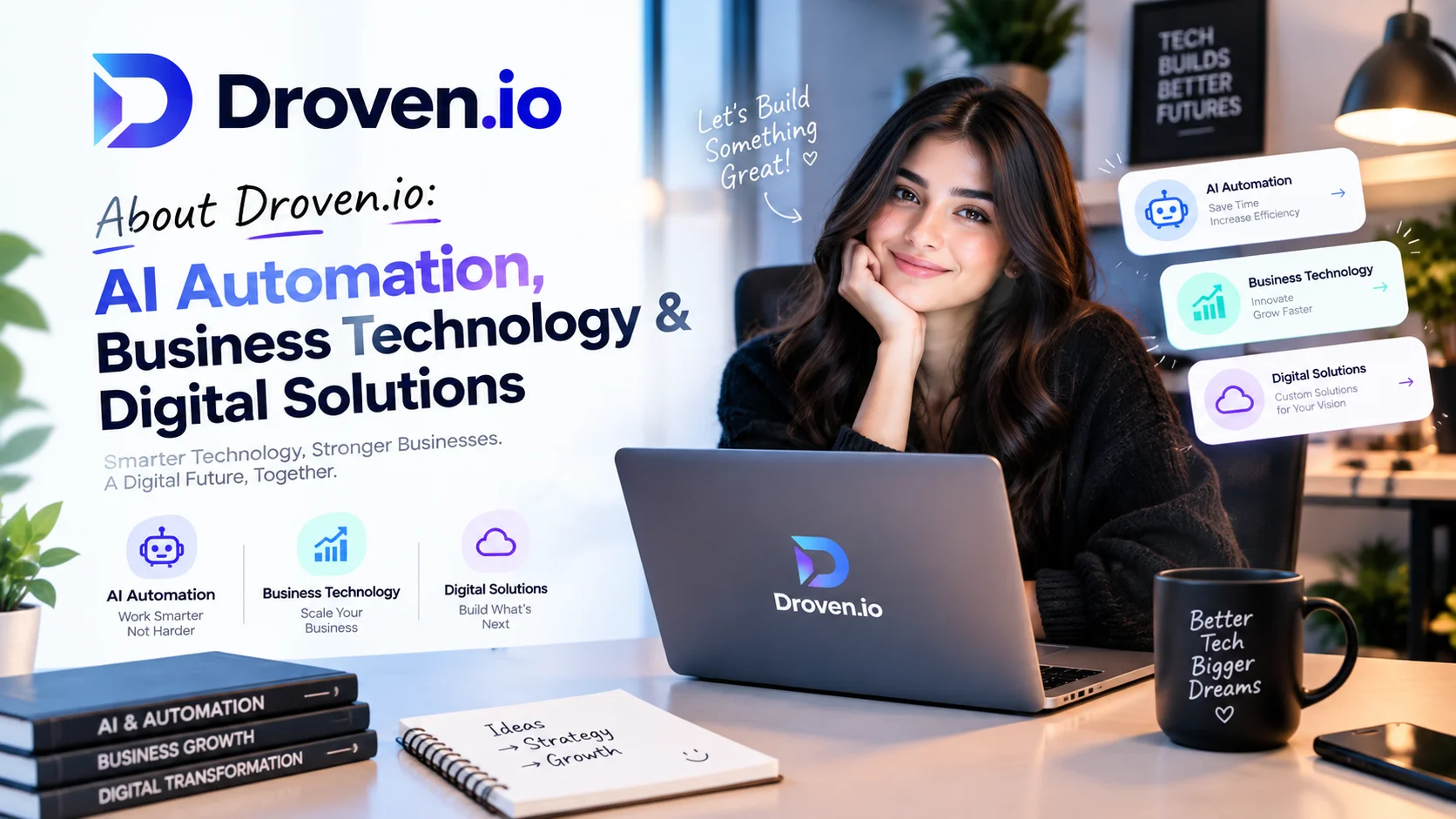
Wondering what Droveon io actually is behind all the online chatter? You aren’t alone. Thousands of business leaders and developers search daily to figure out if it is an actionable software app, a SaaS tool, or just an executive research hub. Simply put, droven.io is a vendor-neutral tech education platform covering AI tools, cloud infrastructure, and modern software trends.
At Software Cora, we take those high-level concepts and turn them into real, production-ready software. Here is everything you need to know about the platform, real user experiences, and how to build these automations yourself.
What is Droven.io? (Understanding the Core Platform)
To eliminate confusion from the very start, we must clearly define what droven.io actually is and what it is not.
| DROVEN.IO
| (Research, Editorial & Knowledge Layer)
| – In-depth articles on machine learning & AI tools
| – Educational breakdown of DevOps & Cloud Architecture
| – Tech job market trends & AI career roadmaps
| – High-level overview of enterprise digital transformation
| SOFTWARE CORA
| (Engineering, Execution & Service Layer)
| – Custom AI Agent & RPA Bot Development
| – End-to-End Cloud Migration & Serverless Infrastructure
| – Enterprise API Integration & Workflow Orchestration (n8n, Make)
| – Full-Stack Web, Mobile, and Microservice Engineering
The Knowledge Layer vs. The Execution Layer
- Droven.io is a Content & Research Platform: It operates as an independent, vendor-neutral technology publication. It publishes detailed technical guides, industry breakdowns, software market analyses, and career advice. It does not host active cloud databases, sell proprietary software licenses, or provide a dashboard where you can build automated bots directly.
- SoftwareCora is an Engineering & Delivery Partner: When you read about droven.io RPA and business automation or droven.io cloud computing guide concepts, you need a team of engineers to build those systems. That is where Software Cora steps in, taking theoretical architectural models and turning them into secure, scalable, live software platforms.
Core Content Pillars Covered by Droven.io
Understanding new technology can feel overwhelming when every site is trying to sell you something. Droven.io breaks its content down into four easy-to-understand focus areas so you can quickly find the exact research and guidance you need:
- Driven. io AI Automation Tools: This section focuses on making smart technology simple. It breaks down how autonomous AI agents work, how to connect Large Language Models (LLMs) like GPT into existing business apps, and how to use simple drag-and-drop workflow builders (like n8n or Make) to automate daily tasks without writing complex code.
- Droven.io IT Services in USA: Perfect for business leaders looking to build or hire tech teams. It gives clear, honest advice on hiring developers within the US versus outsourcing overseas, while breaking down essential privacy and security laws (like HIPAA for healthcare, SOC2 for data protection, and GDPR) in plain language.
- Droven.io DevOps Tutorials & Cloud Infrastructure: Designed for developers and IT teams who want to build stable, fast-loading software. These step-by-step guides explain how to package apps using Docker, manage scaling with Kubernetes, set up automatic testing pipelines (CI/CD), and manage cloud servers through code rather than manual setups.
- Droven.io AI Career Roadmap & Job Insights: A practical resource for tech professionals, students, and career changers. It offers realistic guidance on learning in-demand AI skills, understanding how the tech job market is changing, and finding top-paying roles in the modern US tech sector.
Community Insights & Real User Reviews
Before investing time reading tech portals or adopting new tools, you should know what real developers, managers, and enterprise leaders think. We aggregated feedback from various public discussions, tech community channels, and editorial platform comments to compile an authentic droven.io review.
What Users Are Saying
“I spent two hours searching for the ‘login page’ of Droven.io, assuming it was a web scraper tool like ParseHub or Apify. Once I realized it was a tech editorial site, the content actually saved me weeks of architectural headache. They explained RAG pipelines in a way my non-technical co-founder could finally grasp.”
Software Architect, FinTech Startup
“The articles covering droven.io’s best tech tools for developers gave us a great starting point for cleaning up our internal DevOps stack. Highly recommended for bird’s-eye views, but don’t expect ready-to-copy code scripts for production.”
Lead DevOps Engineer
Verified Pros and Cons Matrix
| Feature Category | Strengths (Pros) | Limitations (Cons) |
| Content Clarity | Explains complex droven.io AI technology without unnecessary academic jargon or fluff. | Does not provide copy-paste code snippets for direct development. |
| Objectivity | Vendor-neutral reviews; does not force expensive proprietary software down your throat. | Lacks an interactive sandbox or live dashboard interface. |
| Industry Relevance | Up-to-date analysis on drovenio AI tools 2026 and modern automation trends. | Broad coverage means niche edge cases require outside consulting. |
| Career Value | Clear, realistic perspectives on droven.io best AI startups in the USA and workforce shifts. | Does not operate as an active recruitment agency or job board. |
Deep Dive: Artificial Intelligence & Automation in 2026
Artificial Intelligence has moved past simple chatbots and text generation. In 2026, enterprise technology will focus heavily on agentic workflows, autonomous execution, and hyper-automation.
[ Unstructured Data ] [ Intelligent AI Layer ] [ Automated Action ]
(PDFs, Emails, Audio) ==> (LLM + Semantic RAG) ==> (ERP Update, API Call)
1. Traditional RPA vs. AI-Driven Automation
For years, businesses relied on basic Robotic Process Automation (RPA). Traditional RPA acts like a macro: if a website button moves 10 pixels to the left, the bot breaks.
By combining RPA with Artificial Intelligence, as highlighted across droven.io’s AI for Business research, we achieve Intelligent Process Automation (IPA):
- Context-Aware Processing: Instead of reading exact screen coordinates, AI models interpret document context, extracting invoice numbers, line items, and addresses regardless of file formatting.
- Self-Healing Workflows: Modern automation tools adapt dynamically to UI changes, minor API schema updates, and unexpected data inputs without throwing fatal errors.
- Human-in-the-Loop (HITL) Validation: When confidence scores drop below a set threshold (e.g., 92%), the system flags the specific anomaly for human review while processing thousands of valid entries automatically.
2. Key AI Tools and Frameworks
When reviewing droven.io’s enterprise tech innovation trends, several core technologies emerge as must-haves for modern businesses:
- Orchestration Engines (n8n, Make, Temporal): Connecting disparate software applications via secure REST APIs and webhooks to eliminate manual data transfers.
- Vector Databases (Pinecone, Qdrant, Weaviate): Storing company documents as mathematical embeddings to power instant, private context retrieval for internal AI assistants.
- Local LLM Infrastructure (Ollama, vLLM): Running lightweight, highly specialized language models on private cloud servers to maintain strict data privacy and reduce token costs.
Step-by-Step Guide: How to Implement AI & Business Automation
If you have researched droven.io RPA and business automation and want to turn those ideas into operational business systems, follow this end-to-end practical guide.
1. Phase 1: Process Discovery & Mapping: Identify high-friction operational tasks.
Document every manual process in your organisation. Calculate the exact time and cost spent on task management, like manual lead entry, customer support triage, or contract analysis. Select processes with structured triggers and predictable outputs as primary candidates.
2. Phase 2: Architecture & Tool Selection: Select low-code vs custom code stack.
Choose the right engine for your workload. Use low-code orchestrators (like n8n or Make) for rapid API connectors, or build custom Python/Node.js microservices for high-volume, low-latency enterprise operations.
3. Phase 3: Data Security & Compliance Setup: Establish zero-trust environments and permissions.
Ensure sensitive corporate data remains secure. Implement environment variable encryption, strict API key rotation, and zero-retention policies, so your business’s data is never used to train public-facing AI models.
4. Phase 4: Pilot Building & Exception Handling: Deploy controlled sandbox tests.
Build a prototype workflow in a staging environment. Test edge cases heavily, such as corrupted file uploads, server timeouts, and invalid user inputs, to ensure fallback mechanisms trigger smoothly.
5. Phase 5: Production Rollout & Continuous Optimization: Monitor performance and scale.
Deploy your automation to production. Monitor key metrics including execution latency, API error rates, and direct hours saved. Continuously refine prompt instructions and database indexes based on real-world performance.
Cloud Computing, DevOps & Software Development Practices
A major reason readers trust droven.io DevOps tutorials and the droven.io cloud computing guide is their focus on modern, maintainable engineering habits. Writing clean code is only 20% of the battle; the remaining 80% is maintaining, securing, and scaling that code in production.
+———————————————————————–+
| MODERN CI/CD DEPLOYMENT PIPELINE
| |
| [ Developer Commit ] ==> [ Automated Testing & Linting ]
| | |
| v |
| [ Production Live ] <== [ Docker Image & Vulnerability Scan ]
+———————————————————————–+
Essential Software Development Principles
- Infrastructure as Code (IaC): Never configure production cloud servers manually using point-and-click web portals. Use tools like Terraform or AWS CloudFormation to write infrastructure blueprints as code. This ensures 100% reproducible environments and zero human setup errors.
- Microservices vs. Pragmatic Monoliths: While large enterprise applications often run on microservices managed by Kubernetes, small to medium businesses should start with a clean, modular monolith. Avoid over-engineering systems until your traffic and team size explicitly require it.
- Automated CI/CD Pipelines: Implement automated testing pipelines using GitHub Actions or GitLab CI. Every single line of code pushed to repository main branches must undergo automated unit testing, security vulnerability scans, and syntax checks before automatically deploying to staging environments.
- Observability and Monitoring: Building applications without logging is like driving at night with headlights turned off. Utilize centralized logging and application performance monitoring (APM) suites (such as Datadog, Prometheus, or Grafana) to catch system errors before your customers do.
Navigating the Tech Job Market & AI Careers in 2026
Both employers and job seekers frequently visit droven.io to analyze workplace shifts. Topics surrounding driven.io ai career roadmap, droven io’s best ai jobs in usa, and droven.io’s best ai startups in usa paint a clear picture of how tech roles are evolving.
Top In-Demand Tech Roles in 2026
The tech industry has shifted from just writing code to building smart, automated, and secure systems. Whether you’re hiring a team or planning your next career move, these are the most in-demand roles shaping the modern workforce:
- AI Systems Architect: Think of this role as the ultimate “blueprint designer” for artificial intelligence. Instead of just using a basic chatbot, they build private internal knowledge search engines (using Retrieval-Augmented Generation / RAG) and coordinate multiple AI bots so they can work together securely without leaking sensitive company data.
- Platform & DevOps Engineer: The engine mechanics of the software world. They make sure developer teams can deploy code quickly and automatically without breaking the website. They also protect the system against unauthorised access and keep expensive monthly cloud bills (like AWS or Google Cloud) under control.
- Full-Stack AI Integration Engineer: The versatile coders who build modern apps end-to-end. They combine standard app-building tools (like React, Python, or Node.js) with smart AI APIs. This allows them to build features like automated email responses, smart search bars, or instant document summaries right into web and mobile apps.
- AI Security & Compliance Specialist: The digital bodyguards and lawyers of the tech world. As AI introduces new risks, these experts step in to protect algorithms from hackers trying to trick them (prompt injection). They also make sure company AI systems strictly follow international privacy laws like GDPR or SOC2.
- Data & MLOps Pipeline Engineer: The bridge between raw business data and operational AI models. They clean, organize, and feed massive amounts of company data into automated pipelines so AI models stay accurate over time instead of getting slow or outdated.
Why Choose SoftwareCora as Your Engineering Partner?
Reading articles on droven.io gives you valuable strategic vision and conceptual awareness. However, translating high-level concepts into reliable, production-ready software systems requires dedicated engineering execution.
At SoftwareCora (https://softwarecora.com/), we serve as the technical engine behind fast-growing companies, mid-market businesses, and ambitious enterprises worldwide.
STRATEGY & RESEARCH PRODUCTION EXECUTION
(Driven.io) (Software Cora)
- Industry Analysis • Custom AI & RPA Engineering
- Concept Roadmaps ==> • End-to-End Web/App Development
- Tool Comparisons • DevOps & Cloud Infrastructure
- Educational Guides • Long-Term Maintenance & Support
Our Core Engineering Capabilities
- Custom AI & RPA Development: We build tailored automation bots, custom AI pipelines, and private LLM tools built explicitly around your proprietary business rules.
- Full-Stack Web & Mobile App Engineering: From responsive SaaS dashboards to high-performance mobile applications, our team writes clean, fully documented, and scalable code.
- Cloud Architecture & DevOps Services: We design, migrate, and optimise cloud systems on AWS, Google Cloud, and Azure, ensuring high uptime, rock-solid security, and optimized hosting costs.
- Enterprise Software Modernisation: We upgrade aging legacy platforms into fast, modern API-driven architectures without causing business downtime.
Frequently Asked Questions (FAQ)
What is droven.io used for?
Droven.io is a free educational publication and tech blog. It publishes articles, guides, and strategic breakdowns covering AI tools, cloud computing, DevOps practices, software engineering, and technology career roadmaps.
Is Droven.io a free platform or paid software?
Droven.io is entirely free to read. It is an online media property and educational blog, not a paid software tool, web scraper, or subscription SaaS product.
Where can I find official droven io contact or about us information?
You can find official team bios and contact channels directly by navigating to the Droven. I’m in contact with Droven. io Contact Us or Droven.io About Us links in the website footer menu on their official domain.
Can Droven.io build custom software or automation for my company?
No. Droven.io publishes educational and research content only. If you need a team of experienced software engineers to design, build, and deploy custom software, AI automations, or cloud architecture, you should partner directly with Software Cora.
How do I get started with AI automation for my business?
The best way to start is to identify your most time-consuming manual workflows, map the data flow, and consult with Software Cora’s software engineering specialists to build a secure, scalable automation system.
Ready to Turn Automation Concepts into Production Software?
Don’t let valuable technical insights remain stuck on the reading list. Visit Software Cora today to schedule a consultation with our senior software engineering team and build software that scales your enterprise.
