

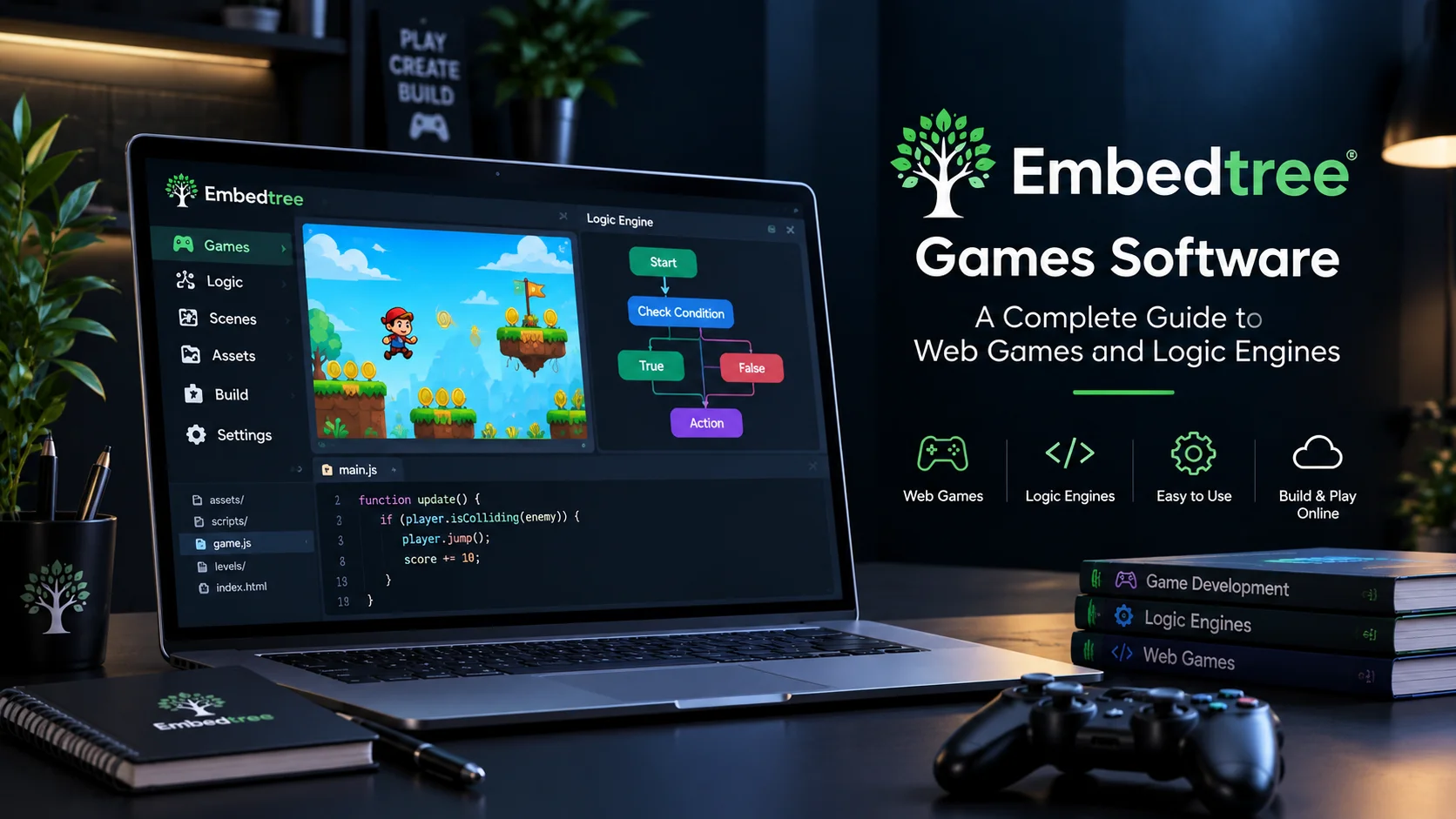
If you have ever tried to add a mini-game or an interactive quiz to a website, you know how painful it can be. Traditional game engines make your web pages slow, take forever to load, and often break on mobile screens.
That is why developers use embedtree games software. It’s a simple, lightweight way to build games using decision trees like branching stories, puzzle flows, or casino logic, and embed them directly into any web page without slowing down your site.
At Software Cora, we break down tech tools so you can make smart software choices without getting stuck in messy code. Let’s look at how embedtree software works and how you can use it.
What Is Embedtree Games Software?
Embedtree games software refers to game development tools that use tree-based data structures. Think of a tree with a trunk and branches: the game starts at one main point, and depending on what the player clicks or decides, the game branches off into different paths or outcomes.
These tools are built specifically for embedtree games and software setups, meaning you can copy a tiny block of code (like an <iframe> or HTML5 script) and paste it straight into WordPress, Shopify, or any custom website.
[ Start Screen / Root Node ]
│
┌──────┴──────┐
▼ ▼
[ Choice A ] [ Choice B ]
│ │
┌──┴──┐ ┌──┴──┐
▼ ▼ ▼ ▼
[Win] [Lose] [Bonus] [Retry]
Games Embedtree Software & RNG Systems
One specialized area where this technology really shines is in casino-style web games, specifically RNG software for video poker and keno game embedtree modules.
In games like Video Poker or Keno, players expect two things: fairness (random outcomes) and smooth gameplay (fast visual feedback). To achieve this, two background systems work together seamlessly:
- RNG (Random Number Generator) Engine: This acts as the unseen, secure referee. The system generates cryptographically random values behind the scenes to guarantee that every card dealt in Video Poker, or every drawn ball in Keno, is 100% fair, unbiased, and unpredictable.
- Embedtree Logic Engine: Once the RNG picks a number, the embedtree engine takes over. It acts like a fast visual flowchart, taking that random result and routing it through logical branches:
- Example: RNG Result (Deals a Pair of Jacks) $\rightarrow$ Branch Check (Is value $\ge$ Jacks?) $\rightarrow$ Trigger Win State $\rightarrow$ Play Animation $\rightarrow$ Update Player Bankroll.
By packaging this entire workflow into a single embedded module, gaming portals can drop self-contained, light video poker or Keno widgets directly into any web page without heavy game installs or slow loading times.
How to Embed Interactive Decision Trees into Game Software
If you want to build a decision-based game and drop it onto your website, follow this simple 3-step process:
Step 1: Map Your Logic Tree
Before writing any code, sketch your choices out on paper or a digital whiteboard. Decide what happens when a player clicks Option A versus Option B. Every choice should branch out logically until it hits a final scene or result.
[ Root: Forest Start ]
│
┌─────────────┴─────────────┐
▼ ▼
[ Choice A: Cave ] [ Choice B: River ]
│ │
┌─────┴─────┐ ┌─────┴─────┐
▼ ▼ ▼ ▼
[ Found Gold ] [ Trap! ] [ Built Raft ] [ Swept Away ]
Step 2: Set Up Your JSON Data
Save your game’s dialogue, questions, and choice branches in a clean, human-readable JSON format. This allows the game engine to read your options dynamically without changing the core script:
JSON
{
“game_title”: “Forest Quest”,
“scene_id”: “forest_start”,
“prompt”: “You see a dark cave on the left and a rushing river on the right. Where do you go?”,
“options”: [
{
“text”: “Enter Cave”,
“next_scene”: “cave_scene”,
“required_item”: “torch”
},
{
“text”: “Cross River”,
“next_scene”: “river_scene”,
“required_item”: “raft”
Step 3: Embed It on Your Web Page
Once your game engine and JSON tree are hosted, copy your generated embed code and paste it into your website editor (such as WordPress, Webflow, or custom HTML):
HTML
<!– Responsive Embedded Game Container –>
<div style=”width: 100%; max-width: 800px; margin: 0 auto;”>
<iframe
src=”https://yourdomain.com/my-tree-game”
width=”100%”
height=”500″
style=”border: none; border-radius: 8px; box-shadow: 0 4px 12px rgba(0,0,0,0.15);”
allow=”fullscreen”
loading=”lazy”>
</iframe>
</div>
Key Highlights for Your Site Visitors
- Lightning-Fast Load Times: Because the tree logic relies on lightweight JSON text instead of heavy video files, games load instantly on mobile phones.
- No Code Updates Needed: To change a storyline or fix a typo, you simply edit the JSON file—you don’t have to rebuild the entire game code.
- Plug-and-Play Integration: The <iframe> snippet works on any website builder without needing complicated database plugins or server setups.
Comparison of Tools for Creating Web-Based Mini-Games
Here is how popular web-game tools compare when building light, embeddable games:
| Software Tool | Best Used For | Tree & Branching Support | How Easy to Embed? |
| Twine | Text-based narrative & decision games | Excellent (Visual node graph) | Super Easy (Exports as a single HTML page) |
| Construct 3 | 2D arcade mini-games | Good (Uses event sheets) | Easy (Simple HTML5/iFrame export) |
| Phaser.js | Custom JavaScript Web Games | Custom (Built via code arrays) | Developer-Friendly (Native JS embed) |
| Ren’Py | Visual novels & story RPGs | High (Script-based branches) | Medium (Requires HTML5 web export) |
Frequently Asked Questions
What software options are available for creating tree-structured games?
The top tools for building tree-structured games are Twine (free, node-based story creator), Articy: Draft (professional branching tool), Ren’Py (visual novel engine), and Inklewriter (simple online choice engine).
Explains software for embedding interactive game experiences.
It refers to lightweight engines that convert game code into web-friendly formats (like HTML5, JavaScript, or WebAssembly). These tools allow games to run inside standard web browsers, so you can paste them into any website like a YouTube video.
Which companies specialize in tree-based game development tools?
Key software creators include Twinery (Twine), Inkle Studios (Ink engine), and Nevigo (Articy: Draft). Major engines like Unity and Unreal also offer visual behaviour tree plugins for handling game logic.
What are the leading platforms for developing lightweight browser games?
The most popular platforms are Construct 3 (no-code 2D engine), Phaser.js (open-source JavaScript framework), Twine (text/choice games), and Godot (lightweight open-source 2D/3D engine).
How much does it cost to license a game embedding framework?
- Free Options: Twine, Phaser.js, and Godot are all 100% free with no royalty fees.
- Paid Subscriptions: Tools like Construct 3 cost around $100 to $200 per year.
- Enterprise/Casino Engines: Specialized RNGs or white-label mini-game engines can cost anywhere from $1,000 to over $5,000 in licensing fees.
Best platforms for developing narrative games with branching paths?
Twine and Ink by Inkle are hands-down the best choices. They give you a visual map of all your story branches so you can track complex paths easily.
Where can I find tutorials for integrating small games into websites?
You can find great step-by-step guides on YouTube (search “Embed HTML5 games in WordPress”), the Mozilla Developer Network (MDN), and developer forums like Itch.io.
Where can I find software to design games using embedded tree algorithms?
You can download Twine for free at Twinery.org, access Ink at Inkleby.com, or browse the Development Tools section on Itch.io.
Build Smarter Web Tools with Software Cora
Adding interactive tools and mini-games keeps visitors on your website longer and boosts user engagement.
Got a software topic you want to write about?
We welcome original guest contributions on AI, SaaS, and tech trends.
Join as a Contributor — Read Our Write for Us Guidelines
