

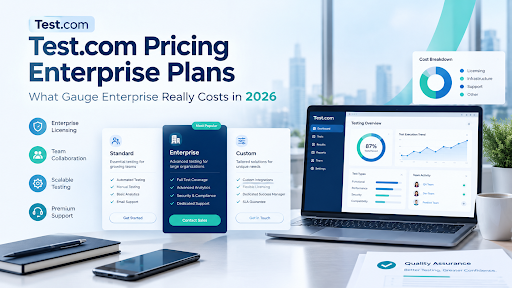
If you searched for test.com pricing enterprise plans, here is the short answer. The testing platform sold under the Test.com name is Gauge, and its Enterprise plan starts at $10,000 per year, plus $1,000 per year for hosting and a $2,000 one-time setup fee. That makes the first-year starting cost about $13,000.
But that number is a starting point, not a quote. Gauge says organizations running more than 10,000 tests a year move to volume-based pricing from $3 per test, and the published pages leave a few things unclear. This guide walks through what is published, what is not, and what to ask before you sign.
Prices below were checked on Gauge’s own pricing and Enterprise pages in October 2026. Vendors change pricing often, so confirm the current figures before you budget.
What Is Test.com Actually Selling?
The name sounds like a simple quiz maker. It isn’t. Gauge is an exam and certification platform. Organizations use it to build tests, deliver them online, manage candidates, award certificates, and track credentials over time.
It also helps to know what Test.com is not, because the search term pulls in unrelated results:
- QA test management tools such as TestRail or TestCollab help software teams manage test cases. They are a different product category.
- The test.com domain name itself is a separate topic from the testing platform.
If your goal is running professional exams, certifications or training assessments, Gauge is the product this article covers.
Who Actually Needs an Enterprise Exam Platform?
Enterprise exam software makes sense when testing is a process, not an event. Picture a hypothetical professional association that certifies 20,000 technicians a year. It needs far more than a way to ask questions.
- A large question bank and different exams for different certification levels
- Passing-score rules, time limits and attempt limits
- Candidate accounts, registration and online payment
- Proctored exams for the high-stakes tests
- Certificate issuing and expiry tracking, with renewal reminders
- Reports for administrators, and links to its CRM or learning system
A free quiz tool or a set of spreadsheets starts to break at that scale. Gauge draws its Enterprise line at 10,000 tests per year, which is roughly where manual workarounds stop being practical for most programs.
If that doesn’t describe you, keep reading anyway. The Professional plan below may be the better fit, and it costs a fraction as much. And if you are still deciding which tools to buy first, our guide to startup tools for each stage shows how to sequence the spend.
Test.com Pricing at a Glance
Gauge publishes two plans, and the dividing line is annual test volume.
| Professional | Enterprise | |
| Built for | Growing credentialing bodies | Large-scale certification programs |
| Software | From $750/year | From $10,000/year |
| Hosting | $250/year | $1,000/year |
| Setup (one time) | $500 | $2,000 |
| First-year starting total | About $1,500 | About $13,000 |
| Recurring cost after year one | About $1,000/year | About $11,000/year |
| Volume | Eight usage-based pricing levels | More than 10,000 tests per year |
Two more details from the pricing page are worth knowing. Gauge offers a “Build Your Own Estimate” tool where you pick your exam volume and features and see the annual cost and cost per exam update live. Its default view shows $1,000 per year all-in at up to 500 exams, which works out to $2.00 per exam. And proctoring sessions are listed as available separately, so they are not part of the base price.
How Enterprise Pricing Works
There are three published charges and one volume rule.
Software: $10,000 per year. This is the headline starting price.
Hosting: $1,000 per year. Listed separately, so the recurring starting cost is $11,000.
Setup: $2,000, one time. This lands in year one only.
Volume pricing: from $3 per test. For programs above 10,000 tests a year, Gauge says pricing moves to a per-test model that starts at $3 and falls as volume rises.
The part that doesn’t add up yet
Here is something the published pages don’t explain. If you run exactly 10,000 tests at $3 each, that is $30,000, which is far above the $10,000 starting price. So the two numbers can’t both describe the full cost of the same program in a simple way.
Maybe the $10,000 is a platform floor and per-test charges apply on top. Maybe it is a minimum commitment that per-test usage draws down. Maybe the $3 rate only applies to certain volumes. The pages don’t say, so this is the first question to put to sales in writing.
There is also a small inconsistency in how the top end is described. The pricing page says the highest-volume customers pay well under $1 per test, while the Enterprise page FAQ says well under $3. Treat both as marketing language and ask for an actual rate card at your volume.
A Worked Example: Budgeting a 12,000-Test Program
Because the published pages don’t show how the $10,000 start and the $3-per-test rate fit together, it helps to run both readings side by side. The figures below are illustrations built from Gauge’s published starting prices. They are not a quote, and they leave out proctoring.
| Scenario | Assumption | Estimated first-year cost |
| Professional, small program | About 500 exams a year | About $1,500, then $1,000 a year |
| Enterprise, “floor” reading | 12,000 tests, the $10,000 start covers them | $13,000, then $11,000 a year |
| Enterprise, “per-test” reading | 12,000 tests at $3 each | About 39,000(36,000 plus $3,000 hosting and setup) |
Under the floor reading, 12,000 tests work out to about $1.08 per test in year one and about $0.92 after that. Under the per-test reading, the cost is $3.00 before any volume discount. That is a gap of roughly $26,000 in year one for the same program.
This is why the clarifying question matters more than the headline price. Get the answer in writing before you compare Gauge with anyone else.
What Does Enterprise Include?
Gauge says Enterprise volume pricing comes with every feature included, which is a useful contrast to platforms that charge for each module. The Enterprise page also promises custom pricing built around your estimated exam volume, with room to renegotiate as the program grows, and cites 99.9% uptime.
Gauge also supports integrations. According to a third-party software directory profile, it offers an API that connects to proctoring providers such as ProctorU and ProctorFree. Confirm the current integration list with the vendor, especially if you need single sign-on or a link to your CRM or learning system.
One caution: because proctoring sessions are sold separately, a program that proctors every candidate could see a very different total from one that only proctors a final exam.
Gauge Pros and Cons
Pricing pages tell you what a vendor wants you to see. Here is a more balanced read, based on what Gauge publishes and what is missing.
What works in Gauge’s favor
- Published starting prices. Many enterprise exam platforms hide everything behind a sales call. Gauge lists software, hosting and setup for both plans.
- A live estimate tool. You can enter your volume and features and see the annual total and cost per exam before talking to anyone.
- Room to grow. Professional has eight usage-based levels, so a small program can scale before it has to move to Enterprise.
- Every feature at volume pricing. Gauge says Enterprise volume pricing includes every feature, so you are not buying modules one by one.
- Broad language support. Gauge lists availability worldwide in 26 languages on its Professional plan, which matters for international candidates.
- No card needed to start. The pricing page notes that no credit card is required, and that support is white-glove on every plan.
What to watch
- The pricing structure is unclear at scale. The link between the $10,000 start and the $3-per-test rate isn’t explained.
- Proctoring costs extra. It is sold separately, so your real total depends on how many exams are supervised.
- Only starting prices are published. Real Enterprise pricing is custom, and renewal terms aren’t listed.
- Retake rules aren’t public. How attempts are counted affects both your plan level and your bill.
- Independent reviews are thin. The G2 listing I found for Gauge was unclaimed and showed no ratings, so most of what you can read is vendor-supplied. Claims such as 99.9% uptime come from Gauge itself.
None of these are dealbreakers. They are the points where a short written answer from sales removes most of the risk.
Professional or Enterprise: Which Fits?

The simplest test is volume.
- Under a few thousand tests a year: Professional is almost certainly enough. The first year is about $1,500, and the usage-based levels let you grow without switching plans.
- Approaching 10,000 tests a year: Compare Professional’s higher levels against an Enterprise quote. The estimate tool helps here.
- Above 10,000 tests a year, with formal certification: This is the range Enterprise is designed for, and where negotiating volume pricing matters most.
If you run a few hundred assessments a year, Enterprise is hard to justify. If exams are your main revenue, the software price matters less than whether the platform handles registration, delivery, results and credentials without extra manual work.
How Gauge Compares With Another Enterprise Exam Platform
Most “enterprise testing” results are QA tools, so there are few direct comparisons. One real assessment-platform alternative with published enterprise pricing is TestInvite.
| Gauge Enterprise | TestInvite Enterprise | |
| Starting price | $10,000/year plus $1,000 hosting and $2,000 setup | From $9,900/year (Pay as You Go segment) |
| Pricing model | Volume-based, from $3 per test above 10,000 tests | Credits consumed per test on the standard segment |
| Flat-fee option | Not published | Unlimited Testing from $40,000/year |
| Pricing terms | Published starting prices, custom quote | Custom, starting figures only |
The headline prices look close, but the structures differ. TestInvite separates a credit-based segment from an unlimited flat-fee segment, which makes high-volume budgeting easier to predict. With Gauge, you need the written breakdown described below.
Hidden Costs and Budget Traps
The license is rarely the whole bill. These are the items to price before you sign, since none of them is covered by the published starting figures.
- Proctoring. Listed as available separately. Per-session pricing can outweigh the software for a program that proctors every candidate.
- Retakes and practice exams. If each attempt counts as a test, a 10,000-candidate program can pass the threshold sooner than expected.
- Integrations. Connecting a CRM, learning system or payment tool can take developer time even when the platform supports it.
- Migration. Moving an existing question bank and candidate history takes staff hours, and sometimes vendor hours too.
- Overage. Gauge’s support material mentions billing for usage above what was paid for, so under-forecasting has a price.
- Renewal. A strong first-year price means little if renewals step up. Ask what the second-year number is.
- Your own team’s time. Building exams, training administrators and handling candidate support all cost hours.
A cheaper platform that needs three people to move results between systems by hand is not cheaper. Compare total operating cost, not license cost.
How to Estimate Your Own Budget
Before you contact sales, collect four things.
- Annual test attempts. Count retakes, practice exams and renewal exams, not just registered candidates, and ask how each is counted.
- Must-have features. Separate essentials (certification, reporting, integrations) from nice-to-haves.
- Systems to connect. List your CRM, learning system, payments and identity provider.
- Proctoring plan. Decide which exams need it and whether candidates or you will pay.
Then ask for a written breakdown that separates software, hosting, setup, per-test charges, proctoring, integrations and migration. Gauge’s own support material mentions that usage above what you paid for can be billed as overage, so an accurate volume forecast protects you.
Security and Candidate Data: What to Check
An exam platform holds names, contact details, results and sometimes webcam recordings. For a certification body, that data is part of your reputation, so the security questions deserve as much attention as the price.
Before you sign, ask for the vendor’s security documentation and get clear answers on these points:
- Where candidate data is hosted, and what the hosting fee covers
- How administrator permissions and access restrictions work
- Whether activity on the platform is logged in an audit trail
- How you can export your data, and what happens to it if you leave
- How the vendor handles candidate privacy rights
If you test candidates in the European Union, data protection law applies to you whatever your size. Our guide to GDPR compliance software for SMEs is a useful starting point for what small and mid-sized organizations need to put in place. Have your IT or legal team review the contract before you commit.
How to Evaluate Gauge Before Committing
Don’t judge a platform from a demo of three sample questions. Test the workflow you will actually run.
- Open the estimate tool and enter your real exam volume and features, then screenshot the result.
- Build one representative exam, including the scoring rules you use today.
- Import a slice of your real question bank to see how clean the import is.
- Create user groups and permission levels that match your administrators.
- Run the candidate side on a laptop and a phone, in the browsers your candidates use.
- Review the reports your certification manager needs.
- Ask someone on your team who didn’t sit through the demo to complete a task without help.
That last step is the most revealing. If your certification manager can run an exam after a short walkthrough, the platform will probably survive a busy exam season. If they can’t, no discount makes up for it.
How to Negotiate Your Enterprise Quote
Enterprise pricing here is custom, which means there is room to negotiate. These are the levers that usually matter.
- Ask for the full rate card. Get the per-test price at several volume tiers, not just the starting rate.
- Clarify what the $10,000 covers. Is it a platform fee, a minimum commitment, or a credit against per-test charges?
- Commit to a realistic volume. Overcommitting wastes money, and undercommitting risks overage. Use last year’s attempts plus expected growth.
- Ask how overage is billed. A fair rate, or a cap, protects you from a surprise in a busy year.
- Price proctoring separately. Get a per-session figure and compare it with using your own provider.
- Negotiate renewal terms. Ask for a cap on annual increases before you sign.
- Request a written, itemized quote. It makes comparison with other vendors possible and leaves a record.
Gauge says its Enterprise pricing leaves room to renegotiate as your program grows. Hold them to that by asking how and when pricing is reviewed.
Questions to Ask Before You Sign

Pricing
- How does the $10,000 starting price relate to the $3-per-test rate?
- Are retakes and practice exams counted as tests?
- What happens if we exceed our volume?
- What is the renewal price?
Features and integrations
- Which integrations and sign-in methods are included?
- Are there API limits?
Proctoring
- Which providers can we use?
- How are proctoring sessions priced?
Migration and exit
- Can existing questions and candidate history be imported, and by whom?
- What happens to our data if we leave?
A Warning About Old Pricing Listings
Some software directories still show Gauge starting at $500 per year, or an Enterprise figure of $3,000 per year. One of those pages notes its pricing was last updated in 2019. Others say Gauge has not provided pricing. Don’t budget from those. Use Gauge’s own pages and get a current written quote.
FAQs
Is Test.com the same as Gauge?
For the testing platform, yes. Gauge is the exam and certification product connected to the Test.com name. The test.com domain and QA tools like TestRail are separate things.
How much does Test.com Enterprise cost?
Gauge’s Enterprise plan starts at $10,000 per year, plus $1,000 per year hosting and a $2,000 one-time setup fee, about $13,000 in year one. Real pricing depends on volume.
How much does Gauge cost per test?
Gauge says Enterprise volume pricing starts at $3 per test and decreases as volume increases. On the Professional plan, the estimate tool’s default shows $2.00 per exam at up to 500 exams.
What is the cheapest Gauge plan?
Professional starts at $750 per year, plus $250 hosting and a $500 setup fee, so roughly $1,500 in the first year and $1,000 after that.
Does Enterprise pricing include proctoring?
The pricing page lists proctoring sessions as available separately. Ask how they are priced for your program.
Is there a free trial?
The pricing page says no credit card is required, but trial terms aren’t spelled out in the pages I reviewed. Ask sales what a trial covers for your plan.
Is Enterprise worth it?
It makes sense for certification bodies running more than 10,000 tests a year that need integrations and volume pricing. For smaller programs, Professional is usually the better value.
Does Gauge charge for retakes?
The published pages don’t say how retakes are counted. Ask whether each attempt counts toward your annual test total, because it changes both your plan level and your per-test cost.
Is hosting included in the Enterprise price?
No. Hosting is listed as a separate $1,000 per year charge, alongside the $10,000 software price and the $2,000 setup fee.
How many tests do I need to qualify for Enterprise?
Gauge positions Enterprise for organizations running more than 10,000 tests per year. Below that, the Professional plan and its eight usage-based levels are the intended fit.
Why do other websites show different Gauge prices?
Some directories carry old listings, and several pricing articles repeat each other. Gauge’s own pricing and Enterprise pages are the only reliable source, and even those can change, so confirm in writing.
Does Gauge support multiple languages?
Gauge’s Professional plan is listed as available worldwide and in 26 languages. Confirm that your specific languages and any right-to-left scripts are covered before you commit.
Can Gauge be used for training assessments, not just certification?
Yes. Third-party profiles describe Gauge as assessment software that tracks learners across courses and awards certifications on completion, so it suits training programs as well as credentialing bodies.
What should I ask about security before buying?
Ask where data is hosted, how access is controlled, whether there is an audit trail, how you can export your data, and how privacy rights are handled. Get the answers in writing.
Final Thought
The published test.com pricing enterprise plans picture is clearer than most vendors offer: Enterprise starts at $10,000 per year, with $1,000 hosting and $2,000 setup, about $13,000 in year one. But treat it as a floor. The unexplained gap between the $10,000 start and the $3-per-test rate, plus separately priced proctoring, means your real cost depends on your volume and workflow.
Before you commit, use the estimate tool, forecast your yearly attempts, and ask for a written quote that separates every charge. If your volume is under 10,000 tests, start by pricing Professional.
Want more buying guides like this one? Browse our business software section for honest comparisons and pricing breakdowns.
Write for SoftwareCora
Share your expertise with SoftwareCora’s audience through a high-quality guest post on AI, SaaS, software, CRM, business technology, or digital marketing.
