

Search for the AI system Zanus and you’ll hit two walls. First, the vendor doesn’t publish prices. Second, a pile of review sites will happily fill the gap with confident numbers that don’t come from the vendor at all.
This guide sticks to what can be traced to a source. It covers what Zanus AI sells, how its server tiers are described, what’s still unconfirmed, how it stacks up against buying NVIDIA hardware or building your own private AI server, and which questions to put on a quote call.
One honest note up front: I haven’t tested a Zanus server. Everything here comes from public descriptions of the product, and I’ve flagged where sources disagree.
Key Takeaways
- Zanus AI sells a private, on-premises AI system: a turnkey server running local language models, a vector store and a set of preinstalled business modules.
- The servers are sold in three tiers (Prime, Quantum and Enterprise Cluster), each configured and quoted individually.
- Pricing isn’t published. Dollar figures circulating online come from third-party sites, not the vendor.
- GPU model, VRAM and memory bandwidth also aren’t clearly published, so performance can’t be compared on paper.
- It fits regulated businesses that want AI inside their own building without hiring ML engineers. It fits poorly if you want to pick your own models or build custom agents.
Direct answer: Zanus AI is a company selling private, on-premises AI systems for businesses: a physical server with local LLMs, a vector database and more than 15 business modules, designed to run without sending data to the cloud. Server prices are quote-only, and several third-party descriptions of the company conflict with each other, so verify details directly with the vendor.
What Is the Zanus AI System?
Based on the vendor’s public descriptions as reported by several sources, Zanus AI sells its product in layers.
Front Office AI is described as an AI “employee” for customer interactions: phone, web chat, quotes and bookings.
Back Office AI is described as an AI operating layer for running the business, with 15+ modules and no coding required. Listed modules include a vector store, AI chat, customers, suppliers, calendar, tasks, automation, web chatbots and an API.
Private On-Premises AI is the same system running on Zanus hardware inside your building. It runs “Zanus OS,” is sold as owned hardware plus a perpetual software license, and is described as air-gap capable, with updates applied by USB if the machine stays disconnected from the internet.
So “AI system Zanus” can mean the software, the hardware, or both. Most of the interest, and most of the questions, are about the on-premises server.
The Three Server Tiers
| Tier | Described as | Reported details |
| Prime | Entry-level server for smaller teams | Reported to store 2,000,000+ business documents |
| Quantum | Multi-user operations with heavier reasoning | Reported 5,000,000+ document capacity, 8U chassis, roughly 120 lb (54 kg), air-cooled |
| Enterprise Cluster | Multi-node deployments across locations | Scope set per project |
Other reported details: peak power draw of about 6 kW with roughly 1 kW at idle, NVMe storage in a RAID 10 configuration, and delivery of around three weeks.
A caution on those numbers. They come from secondary sources reading the vendor’s product pages, and electrical requirements differ between descriptions. One describes a 50A circuit, another four separate power lines at roughly 13A each at 115V. Ask for the official installation requirements in writing before you plan a room for it.
Pricing: Why There’s No Number Here
The short answer on Zanus AI server pricing is that the vendor doesn’t publish it. As of late September 2026, the catalog entries for all three servers reportedly show “Request Quote” instead of a price, and product pages say each server is custom configured.
That’s normal for enterprise infrastructure. It isn’t a red flag by itself.
The problem is what fills the vacuum. Search for the price and you’ll find specific ranges, from entry-level figures into six figures for clusters, repeated across review sites. They don’t come from Zanus, the sites don’t agree with each other, and some describe the product as something quite different from what the vendor says it is. Treat any number you can’t trace to a quote as fiction, and don’t use one in a budget.
What the price is likely to depend on, based on how the vendor describes quoting: number of users, storage needs, AI capabilities required and industry-specific modules. Financing is reportedly offered. Ask for a total cost covering hardware, software license, setup, support, updates and electrical or cooling work, over three to five years.
What’s Confirmed and What Isn’t
| Question | Status |
| Zanus AI sells private on-premises AI servers | Consistently described across sources |
| Three tiers: Prime, Quantum, Enterprise Cluster | Consistently described |
| 15+ preinstalled business modules | Consistently described |
| Air-gap operation | Described by the vendor and secondary sources |
| Published server price | No. Quote-only |
| GPU model, VRAM, memory bandwidth | Not clearly published |
| Which LLMs ship on the box | Not clearly published |
| Founding year and location | Sources differ (Fort Lauderdale vs Pompano Beach, Florida; one says founded in 2022). Verify. |
| What the product is used for | Descriptions vary by source |
| Independent benchmarks or hands-on tests | None found |
| Named customers or case studies | None verified |
That last pair matters. I couldn’t find independent performance tests or named customer references, and some of the pages written about specific industries (manufacturing, aviation) are published by consulting firms with an interest in selling implementation work.
Who Zanus AI Looks Like a Good Fit For
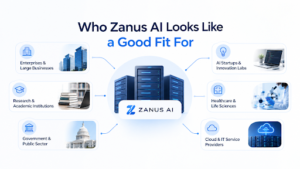
Based on how it’s described, it suits an organization that:
- Handles sensitive information and wants it to stay in the building, such as law firms, medical practices, financial advisers and some government or defense-adjacent work
- Has no machine learning engineers and doesn’t plan to hire any
- Wants one vendor to own the hardware, software and support
- Prefers a one-time purchase to per-seat or per-token cloud billing
- Needs ready-made modules for chat, document handling, scheduling and client management rather than a blank slate
If that’s you, requesting a quote is a reasonable next step.
Who Should Look Elsewhere
It looks like a poor match if you:
- Want to choose and swap your own models as new ones appear
- Need to compare hardware on published specs before you talk to a salesperson
- Plan to build custom AI agents or workflows
- Don’t have a place that can support the power and cooling a server like this needs
- Need independently verified references before committing
Zanus AI vs NVIDIA DGX vs Building Your Own
The comparison people keep making is between an appliance and component hardware. Here’s the real difference.
| Route | What you’re buying | Main strength | Main trade-off |
| Zanus-style appliance | A packaged stack with software preinstalled | Fast time to value, one vendor | Less transparency on hardware, less flexibility |
| NVIDIA DGX-class hardware | Powerful compute with published specs | Maximum control and model choice | You need people to build everything on top |
| Build on rented GPU servers | A private stack you assemble | Lower upfront cost, flexible | Setup, security and maintenance are on you |
| Hosted private AI from an integrator | Managed private infrastructure | Expertise without owning hardware | Ongoing fees, depends on the provider |
Which one wins comes down to a single question: do you have the people? An appliance is, in effect, a way of buying engineering capacity you don’t have. If you already employ it, you’re paying a markup. If you don’t, that markup is the point.
Other vendors sell pre-configured private AI servers too, so Zanus isn’t the only option in the category. Compare at least two quotes.
One more thing about sources. Several of the comparison articles ranking for this topic come from companies that sell their own competing AI products, and they say so openly. That doesn’t make their points wrong, but it’s worth remembering who’s writing when a “which should you buy?” article ends with a pitch.
Questions to Ask Zanus Before You Sign
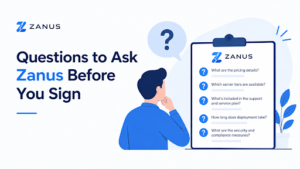
Put these in writing and get written answers.
- Which GPU model, how much total VRAM, and what memory bandwidth?
- Which specific LLMs ship on the server, and under what licenses?
- Can we run models you didn’t bundle, and how?
- What happens when a better open model is released next quarter?
- What are the exact power, cooling and rack requirements?
- What does support cover, for how long, and what’s the response time?
- What does the perpetual license include, and what costs extra after year one?
- How do updates work for an air-gapped machine?
- What are the compliance claims based on? Ask for documentation, not just a statement.
- What’s our exit plan if the company stops shipping updates?
- Can you connect us with a customer in our industry?
- What’s the total cost over five years, including everything?
The compliance one deserves emphasis. Vendors commonly say their products are “designed to support” HIPAA, GDPR or similar requirements. That’s not the same as your deployment being compliant. Compliance depends on how you configure, run and document the system, so involve your legal or compliance people early.
Check the Company Itself
Because third-party descriptions conflict, confirm who you’re dealing with before you send money or data.
Look up the company in the Florida Division of Corporations business search (Sunbiz) to confirm the legal entity, registration date and registered address. Check that the website, email domain and quoted company name all match. Ask for references. Make sure the contract names the exact legal entity.
If you’d like a structured way to do this, our research dossier guide walks through building a sourced, dated vendor profile. And the habit of cross-checking conflicting descriptions applies to any unfamiliar brand, as in our Sosoactive explainer and Adstotally.com review.
Where This Fits in Your Wider Software Choices
An on-premises AI system doesn’t replace everything. It sits alongside your existing tools. If you’re comparing options, our AI software reviews and business software guides cover the wider landscape, and our technology section tracks related hardware and platform topics.
FAQs
What is Zanus AI?
A company selling private, on-premises AI systems: servers with local language models, a vector store and 15+ business modules, plus related cloud software for front-office and back-office work.
Is Zanus AI the same as the Zanus AI system?
People use the terms interchangeably. The “system” usually means the server plus its software, sold as Prime, Quantum or Enterprise Cluster.
How much does Zanus AI cost?
The vendor doesn’t publish server prices. Each configuration is quoted individually, so any figure you see online should be treated as unverified.
Does Zanus AI run without the internet?
It’s described as air-gap capable, with core functions running locally. Updates for an offline machine are reportedly applied by USB. Confirm this in your contract.
What hardware is inside a Zanus server?
Sources mention enterprise GPUs, NVMe RAID storage and a rack chassis, but the GPU model, VRAM and bandwidth aren’t clearly published. Ask for them.
Is Zanus AI better than NVIDIA DGX?
They aren’t the same kind of product. DGX gives you compute and you build everything. Zanus gives you a packaged system. The better choice depends on whether you have engineers.
Is Zanus AI HIPAA or GDPR compliant?
The vendor describes its design as supporting those requirements because data stays on-site. Actual compliance depends on your deployment, so get documentation and consult a compliance professional.
Can I run my own models on it?
That’s a key question to ask. The product is described as a fixed set of modules configured for your industry, not an open platform.
Who is Zanus AI best for?
Regulated or privacy-sensitive organizations that want local AI without an in-house ML team.
How long does delivery take?
Around three weeks has been reported for a configured server, but confirm it in writing.
Where is Zanus AI based?
Sources say Florida, with some placing it in Fort Lauderdale and others in Pompano Beach. Verify through the state business registry.
Are there alternatives?
Yes: component hardware like NVIDIA DGX systems, other pre-configured private AI servers, hosted private AI from integrators, and DIY builds on rented GPU servers.
Final Thought
Zanus AI looks like a reasonable answer to one specific problem: a regulated business that needs AI inside its own walls and has nobody to build it. For that buyer, a packaged server with one vendor on the hook is a legitimate choice.
But the public picture is thin. No published price, no clear GPU specs, no independent tests, no verified customers, and a swarm of third-party pages that disagree about what the product even is.
So treat it as a quote worth requesting, not a purchase worth trusting. Ask the twelve questions above, verify the company, and compare it against at least one other route. If the answers are specific, you’ve found a vendor worth talking to. If they’re vague, you’ve learned that for free.
Write for SoftwareCora
Share your expertise with SoftwareCora’s audience through a high-quality guest post on AI, SaaS, software, CRM, business technology, or digital marketing.
