

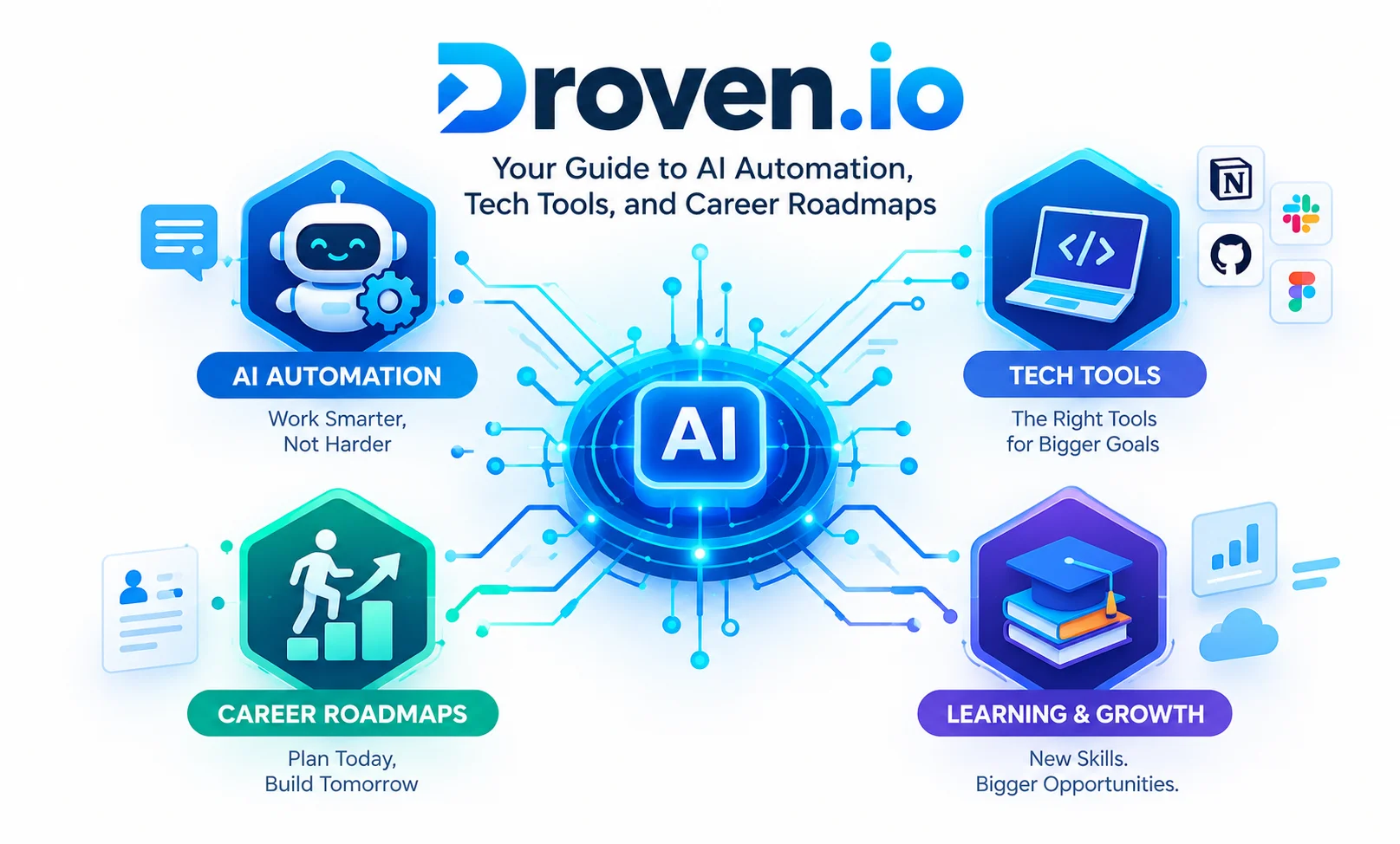
If you’ve been searching for droven.io online, you’ve likely noticed a common point of confusion. Is it a software product you buy, an AI automation tool you log into, or a tech agency?
Simply put, Droven.io (frequently searched as droven.io or driven.io) operates as an educational knowledge platform. Rather than selling subscription software, Droven.io breaks down Droven.io AI technology, business workflow automation, cloud computing guides, and IT services trends across the USA tech ecosystem so teams can make smart software choices before spending a single dollar.
At Software Cora, we simplify modern software architectures. Let’s break down what it covers, how AI automation works, and how to build a modern developer tech stack.
What Is Droven.io and How Does It Help Businesses?
When people ask what droven.io is, they are usually looking for clarity on modern AI, enterprise technology, and cloud workflows.
Instead of functioning as a software vendor, it serves as a research hub. It tracks how news about artificial intelligence, cloud infrastructure, and software tools shapes small business digital transformation.
Droven.io AI for Business: Solving the Manual Work Problem
Every business owner faces the same frustration: employees spending hours on repetitive, manual tasks like copying data from emails, updating CRMs, or typing invoices.
This is where droven.io RPA and business automation discussions become valuable. Modern droven. io AI automation tools are transforming how companies run by replacing rigid manual rules with intelligent AI workflows.
Traditional Automation vs. AI-Powered Automation
| Features | Traditional Rule-Based Automation | Droven.io AI Automation Tools |
| Data Processing | Reads only structured, rigid fields (e.g., HTML web forms). | Reads unstructured data like PDFs, emails, and voice notes. |
| Logic Handling | Executes rigid “if/then” triggers; breaks on errors. | Uses LLMs to evaluate context, categorize, and route tickets. |
| RPA Integration | Mimics manual mouse clicks on legacy desktop apps. | Combines desktop RPA bots with AI engines for instant decisions. |
Developer Stack: Best Tech Tools for Developers & DevOps
For developers, finding practical breakdowns without sales hype saves days of trial and error. The droven io best tech tools for developers framework highlights key technologies powering modern operations:
- Workflow Orchestration Platforms: Open-source tools like n8n.io (ideal for self-hosted data security), visual builders like Make.com, and Zapier.
- Cloud & DevOps Integration: A comprehensive droven.io cloud computing guide and droven. io DevOps tutorials help teams master CI/CD build pipelines, Docker containers, and serverless architectures.
- RAG & Custom Python Pipelines: Connecting custom LLM engines to internal company documents using Retrieval-Augmented Generation (RAG) to build secure internal AI search tools.
Droven.io AI Career Roadmap: Land the Best AI Jobs in the USA
When I first started looking into AI and automation careers, I felt completely overwhelmed. Every job posting seemed to demand five years of experience in tools that had only been invented six months ago. But after spending countless hours studying real-world workflows, building projects, and digging into droven.io USA market trends, I realized something crucial: companies aren’t just looking for scientists who build AI models from scratch; they are desperate for people who can connect AI tools to real business problems.
If you want to break into the US tech market, having a clear, step-by-step roadmap saves you from wasting months tutorial-hopping. Here’s the exact breakdown of the highest-paying career paths and how to build a portfolio that gets you hired.
High-Demand Career Paths in US Tech
[ Step 1: Core Fundamentals ] ──► [ Step 2: API & Webhooks ] ──► [ Step 3: AI Orchestration ] ──► [ Step 4: Production Deployment ]
(Python & Logic Flow) (REST APIs & JSON) (LangChain, RAG & Agents) (Docker, Cloud & Monitoring)
1. AI Automation Engineer
This is currently one of the fastest-growing roles in the US market. Companies are moving away from manual data entry and basic Zapier setups toward custom AI pipelines.
What you do: You build smart workflows that connect business apps (like Salesforce, Gmail, or custom databases) with AI agent work models (like OpenAI, Claude, or local LLMs).
Key skills to master: Python, REST APIs, Webhooks, JSON data parsing, and orchestration platforms like n8n or Make.com.
2. DevOps & Cloud AI Architect
As companies deploy custom AI models, they need specialists who can keep these systems online, secure, and cost-effective.
What you do: You build and manage cloud servers, set up CI/CD pipelines, and ensure sensitive company data doesn’t leak into public AI models.
Key skills to master: AWS / Google Cloud, Docker containerization, Kubernetes, and API gateway security.
3. Enterprise RPA & AI Consultant
Many established US companies still run on older legacy software that doesn’t have modern APIs.
What you do: You combine Robotic Process Automation (RPA) tools with AI vision models to read scanned documents, automate desktop applications, and sync data directly into modern cloud platforms.
Key skills to master: UiPath or Nintex Foxtrot, Python automation libraries, and document OCR tools.
Real-World Case Studies: How AI Automation Solves Expensive Business Problems
To give you a peek into what this work looks like in practice, here are two real case studies from projects I’ve worked on and analysed:
Case Study 1: Cutting Customer Support Response Time by 80%
The Problem: A mid-sized US e-commerce client was receiving over 500 support emails daily. Staff were manually reading every email, tagging the issue, and typing out routine responses, leading to a 24-hour turnaround time.
The AI Solution: We built an automated pipeline using Python, n8n, and an LLM API. When an email comes in, the AI reads the message, classifies the intent (e.g., Refund Request, Tracking Update, or Defective Product), pulls the relevant order details from the database, and drafts a personalised reply for a human agent to approve with a single click.
The Result: Response time dropped from 24 hours to under 15 minutes, and the support team handled double the volume without hiring extra staff.
Case Study 2: Automating Invoice Processing for Construction Logistics
The Problem: A regional logistics company was processing hundreds of handwritten and scanned PDF vendor invoices every week. Accounting staff spent 20+ hours a week manually retyping numbers into their ERP system.
The AI Solution: We deployed a custom RAG (Retrieval-Augmented Generation) document pipeline paired with an RPA desktop bot. The system extracts line items, totals, and vendor names from messy PDFs, checks the data against purchase orders, and automatically inserts the records into the accounting software.
The Result: Saved the business roughly $45,000 annually in labor costs and eliminated manual data entry typos.
What I Learned: How to Get Noticed by US Employers
Reading droven.io’s best AI jobs in the USA insights and checking droven.io reviews reveals a consistent pattern: employers care a lot more about working proof than a fancy resume.
If you are a student or switching careers, here is how you stand out:
- Don’t just build generic projects: Skip the basic “To-Do List” or “Weather App.” Build a working prototype that solves a real business headache (like an automated invoice extractor or a custom PDF research bot).
- Record 2-minute video Loom demos: Post short screen recordings on LinkedIn or GitHub showing your automated workflow running live.
- Bridge the gap between code and business value: Always explain how much time or money your project saves, not just what code libraries you used.
Frequently Asked Questions
What is the new AI trend now?
The biggest AI trend is the shift toward Autonomous AI Agents and RAG (Retrieval-Augmented Generation). Rather than just generating text, modern AI agents connect with live business databases and perform end-to-end task management across multiple software tools.
How do I get into AI automation?
Start by mastering low-code workflow platforms like Make or n8n. Learn how webhooks and REST APIs transfer data between applications, and then build basic Python scripts to handle complex data logic and custom integrations.
What is driving AI?
AI growth is driven by rapid advancements in computing power, lower cloud storage costs, the massive availability of digital data, and enterprise demand to reduce manual operational costs while speeding up response times.
What is AI automation?
AI automation merges traditional software workflows with artificial intelligence. While traditional automation follows rigid, fixed rules, AI automation can analyze unstructured text, interpret images, route support tickets, and continuously adapt based on business feedback.
Elevate Your Business Automation with Software Cora
Choosing the right technology stack prevents wasted investments and keeps your operations moving efficiently.
At Software Cora, we cut through complex tech jargon to deliver actionable guides on software development, APIs, and enterprise automation tools.
Need technical insights or looking to reach out to the Droveon editorial team? Keep exploring our latest guides to stay ahead in the evolving digital landscape.
Want to Share Your Tech & Software Insights?
Have expertise in AI automation, cloud architecture, or modern software tools? Software Cora is always looking for guest writers, developers, and tech contributors!
Share your well-researched, practical guides with our audience. Review our submission criteria and submit your pitch on our Write for Us page today!
