

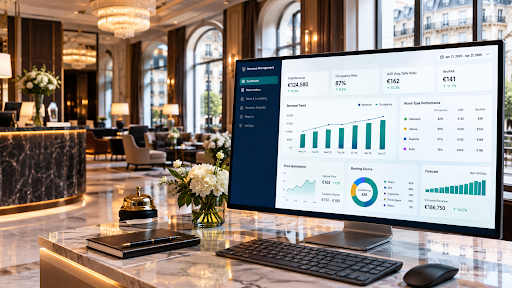
Most French hotels don’t have a pricing problem. They have a Tuesday-morning problem.
It goes like this. A festival gets announced two towns over. A competitor drops their rate. A coach group cancels. And somebody, usually the owner or the front-desk manager, opens three browser tabs and a spreadsheet and changes a few prices by gut feel before the breakfast service starts. Sometimes the guess is right. Often it’s slightly too low, which is the expensive kind of wrong, because nobody ever sees the money that didn’t come in.
If you run a hotel business in France with somewhere between 10 and 300 employees, you are in the zone where this stops working. One property can survive on instinct. A small group with four hotels, an aparthotel, a restaurant and a spa cannot. And you are probably too small for the enterprise-grade tools that large chains use, with their trained revenue teams and long contracts.
This guide covers the hospitality software in France that matters for operators of your size, with a focus on revenue management: what to buy, what to skip and how the main options compare. You’ll get a clear pick at the end.
Two honest disclosures. I haven’t run these systems inside a live hotel for this piece. The comparison draws on 2026 industry rankings, vendor announcements and review-platform summaries, and many of those sources have commercial ties to the vendors they discuss. I’ve leaned on points that appear across several of them. Prices are mostly quote-based in this market, so I haven’t invented any numbers you should budget around.
The Short Answer
- Independent hotels and small groups without a full-time revenue manager: shortlist RoomPriceGenie and Climber. My default pick is RoomPriceGenie, with Climber close behind if French-language support and local proximity matter to you.
- You’re replacing your PMS anyway: look at Mews, which now ships revenue management natively inside the platform, or Cloudbeds and Apaleo if you prefer their ecosystems.
- You need to see the market, not just price inside it: add Lighthouse for rate shopping and market intelligence.
- Larger, branded or luxury portfolios with a trained revenue team: IDeaS or Duetto. For most operators under 300 staff, they’re more machine than you need.
- A single small property: start with a lighter tool or your PMS’s built-in pricing before paying for a standalone system.
The rest of the article explains the reasoning, and why the order of your purchases matters more than the brand names.
Who This Guide Is For
“10 to 300 employees” covers a lot of ground, so let me define the reader.
A 10 to 30 person business is typically one or two independent hotels, a boutique property or a small aparthotel. Revenue management is probably owned by the manager or the owner.
A 30 to 100 person business is often a small group of hotels, or a hotel with serious restaurant and event revenue. Someone may be part-time on pricing, but nobody is a specialist.
A 100 to 300 person business is a regional group or a large resort operation. You may have a revenue manager, or you’re about to hire one, and you’re asking harder questions about forecasting, group business and portfolio reporting.
The advice below flags where each size tends to land.
What Revenue Management Actually Is (and Isn’t)
Revenue management is the practice of setting the right price for the right room, for the right guest, at the right moment. It rests on demand forecasting, competitor awareness, segmentation and distribution control.
A revenue management system (RMS) automates part of that. It looks at your booking pace, historical patterns, events and market data, then recommends or pushes rates. Some systems simply suggest prices for you to approve. Others update your rates automatically within limits you set.
People mix up five different tools, so here’s the map.
PMS (property management system). Your operational core: reservations, check-in, billing, housekeeping. Mews, Cloudbeds, Apaleo and many French systems sit here.
Channel manager. Syncs your rates and availability to Booking.com, Expedia, your own site and other channels.
RMS. Decides what your prices should be.
Rate shopping and business intelligence. Shows what competitors charge and how the market is moving. Lighthouse (formerly OTA Insight) is the best-known name.
Booking engine. The tool on your own website that takes direct bookings.
A single Mews release described the average hotel as running on eight to ten separate software vendors, each handoff costing time and revenue. Whether or not you buy that framing, the practical point is real: the more disconnected tools you run, the more manual copy-and-paste you do, and the more mistakes slip through.
What Matters in France
Generic advice about hospitality software often ignores local reality. Here is what French operators should weigh.
Seasonality and event swings. Many French markets are intensely seasonal or event-driven: ski resorts, Riviera summers, trade fairs, festivals, wine harvests. An RMS has to handle sharp demand spikes and long shoulder periods, and it needs good event data for your region.
Dependence on online travel agencies. Many independent hotels lean heavily on OTAs, and the commission bill is a real cost. A good revenue approach pushes direct bookings and tracks net revenue after commission, not just headline rates.
Taxe de séjour and French billing. Make sure your PMS and any connected systems handle the local tourist tax correctly and produce invoices that fit French requirements.
Electronic invoicing. France’s e-invoicing reform started on 1 September 2026. All VAT-registered companies must be able to receive electronic invoices through an approved platform from that date. Large companies and mid-sized enterprises (ETI) must also issue them from 1 September 2026, while SMEs, micro-businesses and independents must issue from 1 September 2027. For hotels, this mostly affects B2B flows: corporate accounts, tour operators, suppliers. If you’re near the 250-employee line, check which category you fall into. Ask every vendor how they handle e-invoicing and whether they connect to an approved platform.
Point-of-sale rules. If your hotel’s restaurant or bar uses a POS built into your hospitality software, confirm it meets French cash-register certification requirements before you buy.
Personal data. Guest data is personal data, and French regulators take it seriously. Our guide to GDPR compliance software for SMEs in France covers the tools and the obligations.
French-language support. Easy to overlook until your system breaks at 7 a.m. on a Saturday. Ask where support is based and which languages are staffed.
What to Look For in Hospitality Software for Revenue Management
Fit with your PMS. The best RMS in the world is useless if it doesn’t integrate cleanly with your property management system. Check the exact integration, how often data syncs and whether prices push back automatically.
How much your team has to do. Some systems demand a trained revenue manager. Others are built so a general manager can use them in ten minutes a day. Match the tool to the team you actually have.
Transparency. Can you see why the system recommends a price? If the answer is “the algorithm says so,” your team won’t trust it and will override it constantly.
Control and guardrails. You should be able to set minimum and maximum rates, restrict changes around events and keep your own strategy in charge.
Data needs. Some high-end systems want large amounts of historical data. Smaller operators may do better with tools that lean on external market signals.
Multi-property support. If you’re a group, you need portfolio views and the ability to apply strategy across hotels without rebuilding it each time.
Reporting. RevPAR, ADR, occupancy and, if you have food and beverage or spa revenue, a view of total revenue per available room, not just rooms.
Pricing model. Per room, per property, tiered or on quote. Ask what happens to the price as you add rooms.
Support quality and setup time. Review platforms for the European market highlight onboarding speed and support as differentiators for several vendors. Ask for references in France.
Three Ways to Build Your Stack
Before comparing brands, choose an architecture. There are really three.
- An all-in-one platform with revenue management built in. Mews, Cloudbeds and similar vendors now offer native pricing inside the PMS. Pros: one login, one data set, fewer integrations to break. Cons: you’re tied to that vendor, and the built-in RMS may be less deep than a dedicated one.
- A PMS plus a standalone RMS. You keep or choose the PMS you prefer and add a specialist RMS such as RoomPriceGenie, Climber, BEONx, IDeaS or Duetto. Pros: best-of-breed pricing. Cons: another integration to manage and another vendor to pay.
- A market-intelligence layer on top. Lighthouse and similar tools sit alongside your pricing process, giving you competitor rates, demand data and dashboards. Some of these have added AI-driven rate recommendations, but an industry guide cautions that for full RMS functionality, such as forecasting and group displacement, you may want a dedicated system alongside them.
For a French operator with 10 to 100 employees, option 1 or a lightweight version of option 2 usually wins on simplicity. Above 100, option 2 plus intelligence starts to make sense.
Related Reading on Software Cora
The Systems Compared
The table summarizes how each system is generally positioned in 2026 industry coverage. Details change often, so confirm with each vendor.
| System | Category | Best for | Main strength | Watch out for |
| RoomPriceGenie | Standalone RMS | Independents and small to mid-size groups | Practical, controllable pricing without a full-time revenue manager; named best RMS in the 2026 HotelTechAwards | Less depth for complex, large portfolios |
| Climber (Revenue Analytics) | Standalone RMS | European hotels wanting easy setup and support | High ease-of-use ratings and strong support in European reviews | Confirm current ownership, roadmap and integrations |
| BEONx (formerly Beonprice) | Standalone RMS | Independents, chains, resorts | AI pricing with a profitability focus and benchmarking | Check depth of integration with your PMS |
| Mews RMS | Built into PMS | Operators choosing or replacing a PMS | Native pricing in one platform, with channel manager built with SiteMinder | Requires committing to Mews |
| Cloudbeds | PMS with revenue tools | Independents and multi-property operators wanting all-in-one | Combined operations, distribution and revenue | Built-in tools may be lighter than a specialist RMS |
| Lighthouse (formerly OTA Insight) | Market intelligence and pricing | Teams that need to see the market | Rate shopping, benchmarking, demand data | Not a full RMS on its own |
| IDeaS | Enterprise RMS | Large, branded and luxury portfolios | Deep forecasting and analytics | Higher cost; expects trained revenue staff |
| Duetto | Enterprise RMS | Larger groups and resorts | Open pricing model, segmentation | Heavier for smaller teams |
RoomPriceGenie
RoomPriceGenie is aimed squarely at smaller properties and groups. Its pitch is that it gives you the judgment of a revenue manager without the salary, using external market signals rather than demanding mountains of internal history. It won first place for best RMS in the 2026 HotelTechAwards, based on verified client reviews, and review-platform pages list it as widely recommended by hotels in Europe.
It’s also described as rule-based and controllable, which suits managers who want to stay in charge of strategy. A third-party review also points out that it’s a good fit for revenue managers who want to control the strategy rather than be told what to do.
Pick it if: you’re an independent or small group, you don’t have a dedicated revenue specialist and you want results quickly with visible control.
Skip it if: you run a large, complex portfolio with heavy group business and a trained team.
Climber
Climber is the system on this list with the strongest French and European roots. HotelTechReport now lists it as “Climber, a Revenue Analytics Company,” and its European reviews highlight user-friendly design, a strong support team and quick setup, with a published ease-of-use score of 4.9 out of 5 in one head-to-head comparison against BEONx.
Because ownership and positioning can shift after an acquisition, ask for a current product roadmap and references from French customers.
Pick it if: you want a pricing tool with strong support and fast onboarding in a European context.
Skip it if: you need a deep enterprise system with advanced group displacement features.
BEONx (formerly Beonprice)
BEONx pairs AI-powered pricing with market intelligence, benchmarking and a profitability-first approach. It serves independents, chains, resorts and boutique hotels. The profitability angle matters: it aims to optimize the money you keep after costs, not only the headline rate.
Pick it if: profitability and net revenue are your priorities and you want a Spain-and-Europe-based option.
Skip it if: you need a tight, proven integration with a niche local PMS. Verify before committing.
Mews
Mews is a PMS first, and in 2026 it launched an RMS built natively into the platform, along with a channel manager developed with SiteMinder, business intelligence and other tools. The company says it serves around 15,000 customers across 85 countries and has been named best PMS by Hotel Tech Report for three consecutive years.
The appeal is simple: pricing, distribution and operations share one data set. The risk is simple too: you’re committing to a single vendor. Mews also published figures about the impact of its RMS, but those come from its own analysis, so treat them as vendor claims.
Pick it if: you’re choosing or replacing a PMS and like the idea of one connected system.
Skip it if: you’re happy with your current PMS and only need pricing help.
Cloudbeds and Apaleo
Cloudbeds is an all-in-one platform for independents, groups and multi-property portfolios with operations, revenue, distribution and marketing in one system. It serves tens of thousands of properties across more than 150 countries.
Apaleo is an open, API-driven PMS with an app marketplace, billed per room per month with a monthly minimum, no setup fee and a free trial. It suits operators who want to assemble their own best-of-breed stack.
Pick Cloudbeds if: you want a complete system with fewer vendors.
Pick Apaleo if: you have technical appetite and want flexibility to plug in your preferred RMS and other tools.
Lighthouse
Lighthouse, formerly OTA Insight, began as rate-shopping software and has grown into a broader commercial platform with business intelligence, forecasting, market demand data and AI-driven rate recommendations. Review-platform summaries show it recommended across hotel sizes, including small and large properties and luxury segments, and in Europe.
It’s excellent for understanding your market. One industry guide advises asking exactly which AI you’re buying, and pairing it with a dedicated RMS if you need full forecasting and group displacement.
Pick it if: you want to stop pricing blind and make sharper commercial decisions.
Skip it as your only tool if: you need automated pricing with full forecasting.
IDeaS and Duetto
IDeaS is one of the longest-running names in the field, described by one review as the “Rolls Royce” of hotel revenue management, ideal for large hotels with many revenue sources. Industry guides note its higher cost and that it works best with trained revenue teams. Duetto is known for an open pricing model, real-time demand tracking and segmentation insight.
Both are serious systems. For most operators with fewer than 300 employees, they’re more investment and more skill than the job requires, unless you run a branded, luxury or complex resort portfolio.
Other Names You’ll Hear
SiteMinder (distribution and pricing tools), Atomize, FLYR Hospitality (formerly Pace), roommaster and RevEvolve all appear in 2026 lists. Atomize and roommaster, for example, are pitched as accessible options with automated pricing. Treat any list with caution, including this one, because rankings often reflect who paid for placement.
Which System for Which Operator
One independent hotel, 10 to 30 employees. Start with the pricing tools inside your PMS, or a light standalone tool like RoomPriceGenie if the budget allows. Add rate shopping only once you’ve got the basics right.
A boutique or small group of two to five hotels, 30 to 100 employees. RoomPriceGenie or Climber, tied to a PMS they integrate with. If you’re replacing your PMS, put Mews and Cloudbeds in the trial.
A hotel with big restaurant, event or spa revenue. Choose a PMS with a good POS integration, and ask each RMS how it handles total revenue, not just rooms.
A regional group, 100 to 300 employees, with a revenue manager. Add Lighthouse or an equivalent intelligence layer, and consider BEONx, Duetto or IDeaS if you need deeper forecasting and portfolio control.
An aparthotel or serviced-apartment operator. Check that the RMS supports your unit mix and length-of-stay patterns. Not every system treats apartments well.
A resort tied to one big seasonal peak. Ask about event handling, minimum-stay rules and how the system behaves when demand explodes. Test with last year’s peak.
What It Costs
Most vendors in this market don’t publish full prices, and your quote will depend on the number of rooms, properties and modules. Based on how the products are described:
Property management systems often bill per room per month. Apaleo’s model, for instance, is per room with a monthly minimum and no setup fee. Standalone RMS vendors usually price per property or per room, scaling with size. Enterprise systems like IDeaS and Duetto sit at the higher end, which is why guides flag cost as their main drawback.
The honest way to judge cost is against what it should earn. If a system adds even a small percentage to your room revenue, it can pay for itself many times over. Ask each vendor for a documented case from a hotel like yours, and ask how the vendor measured the improvement. Be skeptical of numbers produced by the vendor’s own analysis.
Add the hidden costs: time to clean your data, integration work, staff training and any period when you run old and new systems in parallel.
Related Reading on Software Cora
Do You Need a Revenue Manager?
Not necessarily, and the market has moved to make that easier. Some tools are designed so that a general manager can run pricing in a short daily routine, with rules and guardrails doing the heavy lifting. Others, like IDeaS, assume trained staff.
The deciding factor is the complexity of your business. If you have one or two hotels with mainly transient guests, a lighter tool and a disciplined weekly review is often enough. If you have groups, corporate contracts, events and several properties, a revenue specialist, in-house or outsourced, earns their keep.
Whichever path you choose, assign an owner. An RMS with nobody in charge is just an expensive dashboard.
Your First 90 Days
Weeks 1 to 2: clean your foundations. Check your room types, rate plans and historical data. If your rate structure is a mess, the RMS will be too.
Weeks 2 to 4: connect and calibrate. Integrate with your PMS and channel manager. Set minimum and maximum rates. Decide what’s automated and what needs approval.
Weeks 4 to 8: run in recommendation mode. Let the system suggest prices while you stay in control. Compare its recommendations with what you would have done, and note where you disagree and why.
Weeks 8 to 12: increase automation. Where recommendations have proven reliable, let the system push rates directly within your guardrails. Keep a weekly review.
Beyond 90 days: measure honestly. Compare against the same period last year and against your competitive set, not just against last month.
Mistakes to Avoid
Buying the RMS before fixing the PMS. If your core data is unreliable, no pricing tool will rescue it.
Choosing the biggest name. The enterprise system isn’t automatically the right system. The one your team uses daily is.
Trusting the black box. If you can’t understand a recommendation, you can’t defend it or learn from it.
Ignoring direct booking. Revenue management should include your own website and booking engine. Cheaper-looking OTA rates can quietly erode profit.
Forgetting total revenue. Rooms are only part of the picture if you have food, beverage, spa or events.
Skipping the French admin. Tourist tax, invoicing rules and POS certification catch operators out. Ask early.
Not defining success. Decide in advance which metrics you’ll track, and for how long, before you judge the tool.
Metrics to Track
- Occupancy, ADR and RevPAR against last year and your competitive set
- Net revenue after commission, not just gross
- Direct booking share
- Booking pace and lead time for key dates
- Cancellation rate
- Total revenue per available room, if you have non-room revenue
- Time spent on pricing each week
The last one matters more than it sounds. If a system saves your manager five hours a week, that’s value even before the revenue shows up.
If you’re building the wider technology plan, our Business Software guides and the primer on choosing business software without overspending will help you avoid overlapping tools. For guest data and relationship tools, see our CRM Software reviews, and for direct-booking campaigns and email, our Marketing Software section. If AI pricing is on your mind, our AI Software coverage looks at where AI helps and where it’s still marketing.
FAQs
What is the best hospitality software in France for revenue management?
For independents and small groups, RoomPriceGenie is my default pick, with Climber a strong alternative for European support and quick setup. If you’re replacing your PMS, Mews is worth a trial. IDeaS and Duetto fit larger, more complex portfolios.
What is the difference between a PMS and an RMS?
A PMS runs the operation: reservations, check-in, billing, housekeeping. An RMS decides your prices using demand forecasts and market data. Many PMS vendors now offer built-in pricing, and standalone RMS tools connect to your PMS.
Do I need an RMS for a single small hotel?
Not always. A disciplined weekly pricing routine and your PMS’s built-in tools may be enough. Once you manage several properties or lose sleep over pricing decisions, an RMS pays off quickly.
Is Lighthouse a revenue management system?
It started as rate-shopping software and has grown into a broader platform with forecasting, benchmarking and AI-driven recommendations. For full RMS functionality, an industry guide suggests pairing it with a dedicated system.
How much does hotel revenue management software cost?
It depends on rooms, properties and modules, and most vendors quote privately. Apaleo, for example, bills per room per month with a minimum. Get quotes at your size and ask for documented results from similar hotels.
Can an RMS replace a revenue manager?
For smaller operators, a good RMS can cover much of the routine work, and some are designed for exactly that. For groups with complex contracts and events, a specialist still adds value.
Do these systems work in French?
Support and interface language vary. Ask each vendor where support is based, which languages are staffed and for references from French hotels.
What should I know about e-invoicing in France?
From 1 September 2026, all VAT-registered businesses must be able to receive electronic invoices through an approved platform. Large companies and ETIs must also issue them from that date, and SMEs follow on 1 September 2027. Ask your vendors how they handle it.
How long does implementation take?
Lighter tools can run within weeks. Enterprise systems take longer. Your own data quality affects timing more than the vendor does.
Should I buy an all-in-one platform or best-of-breed tools?
All-in-one is simpler and often better below 100 employees. Best-of-breed gives more depth and flexibility, and it suits operators with technical resources or complex needs.
Are ranking lists like this one trustworthy?
Use them to build a shortlist, not to make the decision. Many are sponsored or written by vendors. Test two or three options with your own data before you commit.
Final Thought
If I were running a French hotel business with 10 to 300 employees, no dedicated revenue team and a PMS I was happy with, I’d trial RoomPriceGenie and Climber side by side for a month, and I’d choose RoomPriceGenie unless French support and onboarding speed tipped it the other way. If I were replacing the PMS, I’d put Mews in the trial and judge its built-in RMS against the specialists. If I needed to see the market clearly, I’d add Lighthouse.
I would not start with IDeaS or Duetto unless I ran a luxury or branded portfolio with the people to use them.
And whichever you choose, fix your rate structure first, assign an owner and measure net revenue, not just rate.
Ready to start? Pick two systems from this list, ask each for a trial with your real data and a reference from a French hotel like yours, and give the winner 90 days. Then compare against last year. For more software comparisons, browse our Business Software and Productivity Software guides.
Write for Us
Do you test gadgets, build desk setups or explain tech in plain words? Write for SoftwareCora and share your ideas with readers who want honest, useful guides. Send us your guest post today →

1 Comment
Pingback: Multi-Resource Scheduling: Methods, Tools & Best Software