

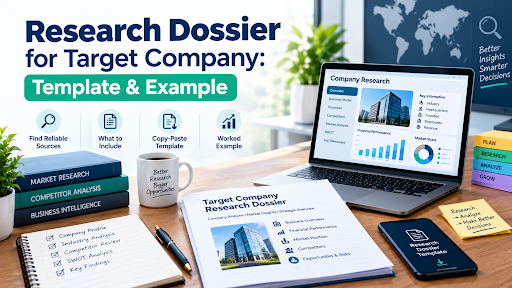
Most company dossiers die in a shared folder. Forty pages, a dozen logos, a paragraph about the CEO’s alma mater, and nobody can say what to do next.
That’s a design failure, not a research failure. A good research dossier for a target company is short enough to read before a meeting and sharp enough to change what you say in it. This guide shows how to build one: what goes in, where to find it, how to mark what you’re unsure about, and a template you can copy. There’s also a worked example, using a made-up company, so you can see the finished thing instead of imagining it
Key Takeaways
- A dossier exists to support one decision: a sales call, a supplier choice, an investment look or a competitor review. Pick the decision first.
- Start with primary sources (registries, filings, the company’s own materials), then add independent coverage.
- Record the date and source for every material fact, and label your confidence.
- “No public information found” is a finding. It isn’t proof that nothing is there.
- Keep it as short as the decision allows. One to three pages covers most sales work.
Direct answer: A research dossier for a target company is a structured, sourced summary of a business, covering who it is, what it sells, how it earns money, who leads it, how it compares with competitors, what is said about it publicly and what risks are visible. Its job is to help you make a specific decision, not to collect every available fact.
What a Research Dossier Is (and Isn’t)
A dossier is a working document. It sits between a quick Google search and formal due diligence.
It isn’t due diligence. Due diligence on an acquisition or large investment involves audited numbers, contract review, lawyers and access to non-public records. A dossier is the preparation you do before that point, or instead of it when the stakes are lower.
It also isn’t a surveillance file. Everything in a business dossier should be professional, lawfully obtained and relevant to a business decision. Home addresses, family details and social media gossip don’t belong, and in many jurisdictions collecting them creates legal trouble for you.
The people who use these most are sales and business development teams, procurement and supply-chain staff, investors doing a first pass, strategy and marketing teams studying competitors, and consultants who need a repeatable format for clients.
Start With the Decision, Not the Company
This is the step most people skip, and it explains why most dossiers feel bloated. Before you open a single tab, write one sentence: “This dossier will help me decide ___.”
The answer changes what you dig for.
For a sales call, you care about priorities, buying triggers and who owns the budget. A recent funding round, a new executive or a hiring spree in a department you sell to matters more than five years of revenue history. You want enough to open the conversation with something specific.
For a supplier decision, the questions flip. Can they deliver on time? Are they financially stable enough to still be here in two years? Do they hold the licences and certifications your industry demands? Reputation and compliance move to the top.
For a quick investment look, you need business model clarity, growth and profitability trends, debt, and ownership. The goal is to decide whether the company deserves proper analysis, not to value it.
For a competitor review, focus on positioning, pricing signals, product gaps and who they’re winning customers from.
Same company, four different dossiers. If you can’t finish the sentence, you aren’t ready to start researching.
What to Include in a Company Research Dossier
Here are the sections that earn their place. Not every dossier needs every one.
Company Identity
Official legal name, trading names, website, headquarters, registration number, founding year, industry and ownership structure. This feels like boilerplate, and it’s where the nastiest errors begin.
Many companies share similar names. Confirm the exact legal entity before you attach any record, news story or review to it. A court case against “Brightline Logistics Inc.” says nothing about “Brightline Freight Ltd.” If you’ve ever had to untangle brand confusion online, you know how common this is. We covered a messy example in our Sosoactive explainer, where one name had been described as four different things by four different sites.
Leadership and Decision-Makers
Founders, the chief executive, senior executives, board members where public. Note their professional backgrounds and any announced changes in the last year or two.
For sales and procurement, add a short “who decides” note: does this company buy through a central procurement team, or through a founder who answers email at midnight? That one line can shape your entire approach.
Stick to professional information. If a detail wouldn’t appear in a company bio or business press, leave it out.
Products, Services and Revenue Model
What do they sell, to whom, and how do they get paid? Subscriptions, one-off projects, transaction fees, licensing, advertising, hardware margins: each tells you something different about the business.
Separate what the company claims from what you can confirm. A product page saying “industry-leading uptime” is a claim. A published status page showing uptime history is evidence.
Financial Position
For public companies, annual reports and regulatory filings are your best source, and they beat any third-party estimate. Private companies disclose less, so you may only find funding announcements, accounts filed with a registry, or credit-agency data.
Look at direction, not just size. Revenue growth with shrinking margins or rising debt tells a different story than steady, profitable growth. Record the reporting period and currency, and note whether a figure is an actual result, a management forecast or someone’s estimate.
If you can’t find financial data, write exactly that: “not publicly available.” Don’t write “no revenue.”
Market Position and Competitors
Who competes for the same customers, and how does the target stack up? Choose comparable competitors: similar customers, similar geography, similar pricing. Comparing a regional supplier to a global giant tells you very little.
Also separate company performance from market growth. A business in a booming industry can still lose share if rivals grow faster.
Reputation and Public Perception
Look at news coverage, published case studies, industry commentary and independent review sites. Look for patterns. One angry review is noise. The same complaint showing up across five independent sources is a signal.
Treat review platforms with care. They contain unverified entries, stale experiences and the occasional competitor sabotage. Always note dates, and distinguish an allegation from a proven finding.
Legal, Regulatory and Compliance Signals
Depending on your purpose, this can mean registration status, licences, sanctions screening, litigation records, regulatory actions and insolvency notices. Use official databases before commentary sites.
One rule matters here: finding nothing doesn’t clear the company. It means you found nothing in the places you looked. Write it that way.
For high-value or compliance-sensitive decisions, bring in qualified legal or compliance professionals. A dossier is a first pass.
Triggers and Timing Signals
This section is the one competitors’ templates usually miss. It records what’s changing right now: a new product launch, a leadership change, an expansion, a layoff, a funding round, a major customer win, a regulatory change hitting their sector.
Triggers tell you when to reach out, when to be cautious and what’s on the target’s mind this quarter.
Risks and Open Questions
End with two short lists: confirmed risks, and things you still don’t know. The second list is more valuable than it sounds, because it tells the reader exactly where to ask questions in the meeting.
Where to Find Reliable Information
Different questions have different best sources. This table covers the main ones for US and UK targets.
| What you need | Good places to look |
| Legal entity and registration | State Secretary of State business search (US), Companies House (UK), OpenCorporates as a cross-check |
| Public company financials | SEC EDGAR filings (US), annual reports on the company’s investor page, Companies House filed accounts (UK) |
| Private company signals | Funding announcements, press releases, filed accounts, credit-agency profiles |
| Litigation | Court records, PACER for US federal cases (fees may apply), UK court listings |
| Sanctions and watchlists | OFAC sanctions list search (US), UK government sanctions list |
| Leadership | Company site, press releases, professional networking profiles, regulatory filings |
| Reputation | News archives, independent review platforms, industry publications |
| Products and pricing | Product pages, documentation, public pricing pages, customer case studies |
| Market context | Trade associations, government statistics, industry reports |
Two habits make this table work. Start at the primary source whenever one exists. And when two sources disagree, record both and flag the conflict instead of quietly picking one.
How to Build the Dossier, Step by Step
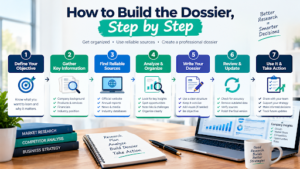
1. Write the decision sentence
Covered above. Don’t skip it.
2. Set a time budget
A first-pass sales dossier can take an hour or two. A supplier vetting might take a day. An investment screen, several. Setting the budget stops research from expanding to fill whatever time exists.
3. Gather from primary sources first
Registry, filings, the company’s own site and announcements. These establish the baseline and the claims you’ll test later.
4. Add independent sources
News, reviews, industry commentary, competitor materials. Their job is to confirm, contradict or add context to what the company says about itself.
5. Log source and date as you go
Don’t do this at the end. By then you won’t remember which number came from where. A simple line after each fact works: “Revenue $12.4M (FY2025, filed accounts).”
6. Label your confidence
Mark each key conclusion as high, medium or low confidence. High means confirmed by a primary source or two independent ones. Medium means a single credible source. Low means inference or an unverified claim.
7. Write the “so what”
Close with what the findings mean for your decision and what to do next. Without this, you’ve written a profile, not a dossier.
8. Set a refresh date
Leadership changes, funding rounds and lawsuits make old information misleading fast. Put a “review by” date at the top.
A Worked Example (Fictional Company)
Here’s a condensed sales dossier for a made-up business. Brightline Freight Ltd is hypothetical and exists only to show the format.
Decision: Should we pitch our route-planning software to Brightline this quarter?
Identity: Brightline Freight Ltd, regional road freight operator, founded 2011, headquartered in the Midlands, registered at Companies House. (Confidence: high; registry confirmed.)
Leadership: Founder-CEO plus a newly appointed Operations Director, announced in a press release this August. (High.) The Operations Director likely owns tooling decisions. (Medium; inferred from role.)
Business model: Contract haulage for retail and food distribution clients, plus a smaller pallet network service. Revenue from per-load contracts. (Medium; company site and one trade article.)
Financials: Last filed accounts show revenue up on the prior year but thinner operating margin. Fuel and driver costs are the stated pressures. (High for the figures, medium for the interpretation.)
Competitors: Three regional operators of similar fleet size. Two advertise real-time tracking for customers. Brightline’s site doesn’t. (Medium.)
Reputation: Mostly neutral. A cluster of driver reviews on employer sites mention scheduling problems, across several independent sources over 18 months. (Medium; pattern, not proof.)
Triggers: New Operations Director. Hiring dispatch planners. Margin pressure. All point to an operations rethink.
Risks and unknowns: Margin trend could limit software budget. Unknown whether they use any routing tool today.
So what: Reach out to the Operations Director within the next few weeks, lead with scheduling efficiency and margin protection, and ask what they use now.
That’s roughly a page. It’s short, sourced, labeled and points at an action.
A Copy-Paste Template
Use this as plain text, a doc or a note in your CRM.
RESEARCH DOSSIER: [Company name]
Prepared: [date] | Prepared by: [name] | Review by: [date]
Decision this supports: [one sentence]
- IDENTITY
Legal name / trading names:
Website / HQ / registration no.:
Industry / ownership:
Confidence + source:
- LEADERSHIP & DECISION-MAKERS
Key people and roles:
Recent changes:
Who likely decides on [our topic]:
- PRODUCTS, SERVICES & REVENUE MODEL
What they sell / to whom:
How they earn:
Claims vs confirmed:
- FINANCIAL POSITION
Figures (period, currency, actual/forecast/estimate):
Direction of travel:
Gaps (“not publicly available”):
- MARKET & COMPETITORS
Comparable competitors:
Where the target leads / trails:
- REPUTATION
Recurring themes (with dates and sources):
Unverified or isolated items:
- LEGAL / COMPLIANCE
Checks done and where:
Findings or “nothing found in [sources]”:
- TRIGGERS & TIMING
What’s changing now:
- RISKS & OPEN QUESTIONS
Confirmed risks:
Unknowns to ask about:
- SO WHAT
Recommended next step:
SOURCE LOG
[Fact | Source | Date accessed]
Using AI Tools Without Fooling Yourself
AI assistants and business databases can save real time. They can summarize long filings, draft first-pass profiles and spot gaps in your outline. If you’re comparing tools for this kind of work, our AI software reviews are a good starting point.
The risks are specific. AI tools can merge two similarly named companies. They can mix figures from different years or present a guess with total confidence. They sometimes invent a source that doesn’t exist.
So the rule is simple: use AI to gather and draft, then check every number, name and legal claim against the original document. Anything that goes into a decision needs a source you’ve opened yourself.
If the dossier will feed your sales pipeline, it helps to store findings where your team can use them. Our guides on CRM tools for growing B2B companies and the best CRM for a small B2B sales pipeline cover options. For wider tool choices, browse our business software category.
Mistakes That Make Dossiers Useless
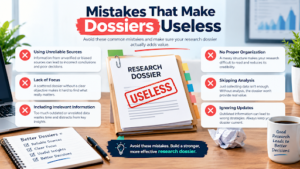
Relying on the company’s own website. It tells you how the company wants to be seen. Useful, incomplete.
Skipping dates. A leadership bio from 2021 or a revenue figure from three years ago can mislead without looking wrong.
Confusing entities. Already mentioned, still the most common error.
Treating estimates as facts. Third-party revenue estimates and employee counts are guesses with decimals.
Reading silence as safety. No lawsuit found isn’t no lawsuit.
Writing for length. Nobody reads page 14. If a section doesn’t change the decision, cut it.
Collecting personal details. Beyond the ethics, it can breach privacy law. In the UK and EU, data about identifiable individuals falls under data protection rules even when it’s publicly available, so keep to professional information and have a clear business reason for everything you record.
FAQs
What is a research dossier for a target company?
It’s a structured, sourced summary of a company covering its identity, leadership, business model, finances, competitors, reputation and risks, built to support a specific business decision.
How long should a company dossier be?
As short as the decision allows. One to three pages works for most sales prep. Supplier vetting and investment screens run longer, but the summary should still fit on one page.
What’s the difference between a dossier and due diligence?
A dossier is preparatory research from public sources. Due diligence is a formal investigation, often with non-public documents and professional advisers, done before a major transaction.
Where do I find financial data on a private company?
Try filed accounts at the relevant registry, funding announcements, press coverage and credit-agency reports. If nothing credible exists, record it as unavailable.
Is it legal to research a company this way?
Researching public business information is normal practice. Stay with lawful sources, avoid private personal data, and follow privacy rules where you operate.
How often should I update a dossier?
Set a review date when you create it. For active deals, check at least quarterly, and sooner if there’s a leadership change, funding event or legal news.
Can AI write the dossier for me?
It can draft and organize, but you need to verify every figure and claim against original sources. Treat AI output as a first draft, never a finished report.
What should a sales dossier focus on?
Priorities, buying triggers, decision-makers and recent changes. Skip deep financial history unless it affects the deal.
Final Thought
If you remember one thing, make it this: a dossier is a tool for a decision, not a monument to effort.
Write the decision sentence. Pull from primary sources. Date and label everything. Put the open questions at the end, because they’re where the real conversation starts. And finish with a “so what” that someone can act on in the next week.
Do that, and your dossier will be the one document in the folder that people actually open.
Write for SoftwareCora
Share your expertise with SoftwareCora’s audience through a high-quality guest post on AI, SaaS, software, CRM, business technology, or digital marketing.
