

Plenty of Malaysian companies have “tried AI.” Most mean they opened a chatbot, played with it for a week and went back to typing invoices by hand.
That’s a shame, because the real savings sit in unglamorous places: a purchase order arriving as a PDF, a customer asking the same stock question on WhatsApp at 9:40 pm, a quotation that takes three days because one person holds all the pricing in their head.
This guide covers business automation and AI solutions in Malaysia from the buyer’s side. What they are, where they pay off, what drives the cost, which government support exists, what the PDPA means for you, and how to pick a provider without getting dazzled by a demo.
Key Takeaways
- Business automation uses rules to run predictable steps. AI handles the steps that involve reading, writing or judgement. Most useful projects combine both.
- The best first projects are repetitive, high-volume and measurable: invoice and document processing, customer enquiries on WhatsApp, quotation drafting and staff knowledge search.
- Start with one workflow and a small pilot on your real data, with a person checking the output.
- Several grants and incentives may help with cost, but eligibility and amounts change. Confirm on the official portals before you plan around them.
- The PDPA, as amended in 2024, affects how AI tools handle personal data. Ask providers specific questions about it.
- Pick a provider on fit, transparency and references, not on how impressive the demo looks.
Direct answer: Business automation and AI solutions in Malaysia are software tools and services that take over repetitive operational work, such as processing invoices, answering routine customer questions, drafting quotations and moving data between systems, while staff review and approve important outputs. They work best when started small on one measurable workflow and connected to the systems a company already uses.
What Are Business Automation and AI Solutions?
The two terms get mixed up, so here’s the simple split.
Business automation means software follows fixed rules. An approved sales order triggers a delivery note. A late invoice triggers a reminder. It’s reliable, fast and cheap to run, but it only works when data is structured and the rules don’t change.
AI solutions deal with the messy bits that rules can’t read: a supplier invoice in a PDF with an odd layout, a customer message in a mix of English and Bahasa Malaysia, a question buried in a 60-page manual. AI reads, interprets and drafts.
Most projects use both. Rules move clean data from A to B. AI turns unstructured input into something rules can handle.
Which Tool for Which Job
| Task | Rules | AI | Typical approach |
| Approved order becomes delivery note | Yes | No | Rule-based workflow |
| Supplier invoice PDF becomes accounting entry | Partly | Yes | AI reads, person checks, rules post |
| Customer asks “is this in stock?” on WhatsApp | Partly | Yes | AI answers from your data, hands over when unsure |
| Monthly sales summary | Partly | Yes | Data pulled by rules, AI writes the narrative |
| Payment reminder after 30 days | Yes | No | Rule-based workflow |
| Draft quotation from a customer request | Partly | Yes | AI drafts, salesperson approves |
A useful test: if you can write the task as an “if this, then that” rule, you probably don’t need AI. If a human has to read something first, you probably do.
Where Businesses Get Real Value

Here are the use cases that tend to deliver, roughly in order of how easy they are to start.
Invoice, PO and Document Processing
AI reads supplier invoices, purchase orders, delivery orders and receipts, extracts the fields and passes them to your accounting or ERP system after a staff member checks them. It cuts typing and typing errors. This is often the cleanest first project because the result is easy to measure: hours spent and error rates before and after.
If your business also sends large volumes of outbound documents, our guide to the output management system covers the other side of the document flow.
Customer Enquiries on WhatsApp and Email
In Malaysia, WhatsApp is where a lot of business happens. AI can sort incoming messages, answer routine questions from your own information, draft replies for the rest and hand over to a human with the context attached.
Two cautions. Answers must come from your data, not from the model’s imagination, and a person should handle anything involving price changes, complaints or commitments. Also check how the provider connects to WhatsApp and what Meta’s message fees will add, since those can change the monthly bill.
Quotation and Proposal Drafting
A first-draft quotation built from your price list, previous quotes and the customer’s request, ready for a salesperson to review and send. The gain is speed, not removing the salesperson.
Staff Knowledge Assistant
Employees ask questions in English, Bahasa Malaysia or Chinese and get answers drawn from your SOPs, manuals and price lists, with a link to the source. It stops company knowledge living in the heads of two or three senior people.
Forecasting and Reorder Suggestions
Models using your sales history, seasonal patterns (Hari Raya, Chinese New Year, school holidays) and supplier lead times can suggest what to reorder and when. This needs history first, so it’s rarely the right opening project.
Reports and Meeting Notes
Daily or weekly plain-language summaries from sales, stock and job data, and meeting notes turned into tasks in your CRM or task list. Useful, though lower impact than the earlier items.
Workflow Automation Across Tools
AI and rules together move information between WhatsApp, email, spreadsheets and your systems. An order email becomes a sales order and a delivery notice, with an approval step where you want one.
If leads from WhatsApp and forms need somewhere to live, see our comparison of CRM tools for growing B2B companies and the best CRM for a small B2B sales pipeline.
What This Looks Like by Industry
Trading and distribution. Quotation drafting, stock enquiries on WhatsApp, invoice and delivery-order processing, reorder suggestions.
Manufacturing. Purchase order handling, production and job reporting, costing support, maintenance notes. Heavier projects may involve sensors or machine data.
Logistics. Booking confirmations, document handling, delivery status messages, exception reporting.
Professional and service firms. Proposal drafting, knowledge search across past projects, client communication drafts, meeting summaries.
Retail and F&B. Customer enquiries, order handling, stock forecasting around peak seasons.
Different industries, same pattern: find the repetitive, document-heavy or message-heavy step and start there.
Malaysia-Specific Factors
Languages. Customers and staff may switch between English, Bahasa Malaysia, Chinese and sometimes Tamil in a single conversation. Ask providers to demonstrate this with your actual messages, not a clean English sample.
WhatsApp-first communication. Check how the AI connects, who owns the number and conversation history, and what happens if you switch providers.
E-invoicing. Malaysia’s LHDN e-invoicing (MyInvois) rollout has been phased by business size. If you’re automating invoices, ask how the solution handles it and check the current requirements for your turnover band with LHDN or your accountant.
Seasonality. Raya, Chinese New Year and year-end shape demand. Forecasting tools need to account for them, and they need enough history to do it.
Data protection. Covered next.
PDPA: What to Ask
Malaysia’s Personal Data Protection Act was amended in 2024, and the changes came into force in stages during 2025. The headline points reported across legal commentary include direct obligations for data processors, mandatory data breach notification, a requirement to appoint a data protection officer in certain cases and new rights such as data portability. Exact thresholds and requirements depend on your situation, so confirm with a lawyer or the Personal Data Protection Commissioner’s guidance.
For an AI project, this turns into practical questions:
- What personal data does the solution actually use, and is that the minimum needed?
- Where is the data stored and processed, and does it leave Malaysia?
- Who can access it, and is activity logged?
- Is your data used to train anyone’s models?
- What’s the process and timeline if there’s a breach, and who tells whom?
- Will the provider sign a data processing agreement?
- Can you delete your data when the contract ends?
If data really shouldn’t leave your premises, private or on-premises deployment is an option, though it brings higher cost and more setup. We look at one example in our AI system Zanus explainer.
Costs and ROI
No honest article can give you one price for “AI automation,” because the cost depends on scope. What it depends on:
- Workflow complexity. Reading clean invoices is easier than reading handwritten delivery orders.
- Volume. More documents or messages usually means higher usage costs.
- Integration. Connecting to your accounting, ERP or CRM is often a bigger cost than the AI itself.
- Subscription vs custom build. A ready-made product is cheaper to start but less tailored. A custom build costs more upfront.
- Usage costs. AI usage, message fees (including WhatsApp) and hosting.
- Training and change management. People need to learn the new process.
- Ongoing support and monitoring. Accuracy needs watching.
Ask for a written fixed quote and a clear split between one-off and recurring costs.
A Simple ROI Test
Take one workflow and measure today’s baseline. The numbers below are made up to show the method:
- Staff key in 400 supplier invoices a month at about 6 minutes each, so roughly 40 hours.
- If AI plus checking brings that down to around 2 minutes each, that’s about 13 hours.
- The difference, 27 hours a month, is the time saved.
Multiply by the loaded cost of that staff time, add error reductions and faster payment cycles, then compare against the monthly cost of the solution. If the saving doesn’t clearly beat the cost, scope smaller or pick a different workflow. Remember the human checking step doesn’t disappear, and the savings come from shifting people toward reviewing instead of typing.
Grants and Incentives to Look Into
Malaysia has several support schemes related to digitalisation and AI. The table summarises what’s been reported. Treat it as a starting list, not as eligibility advice, because amounts, criteria and availability change.
| Scheme | What it’s reported to cover | Notes |
| MSME Digital Grant MADANI (BSN / MDEC) | Matching grant for digital tools, reported at 50% up to RM5,000 | Typically requires purchasing from MDEC-registered or certified providers |
| Malaysia Digital Acceleration Grant, including the AI track (MDEC) | Support for firms adopting or building with advanced technologies such as AI | Reported RM53 million allocated in Budget 2026; stricter eligibility |
| HRD Corp claims (SBL-KHAS, SME Skills Scheme) | Reclaiming approved training costs from your levy, reported up to 100% | For registered employers; applies to approved AI training, not software itself |
| Budget 2026 tax deduction for AI and cybersecurity training | Reported 50% additional deduction for SMEs | Confirm qualifying conditions with your tax adviser |
| Outcome-Based Incentive Framework | Targeted incentives tied to measurable automation and digitalisation gains | Reported as new in Budget 2026; check details |
Practical tips: check the official MDEC, BSN, SME Corp and HRD Corp portals for current rules, ask potential providers whether they’re eligible under any grant, and don’t sign a contract on the assumption that a grant will be approved. Several of these can sit side by side, such as using a digital grant toward software while funding staff training through HRD Corp.
How to Start: A Four-Step Approach
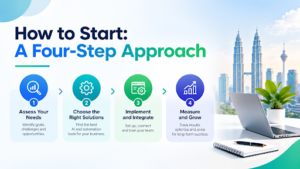
- Find the bottleneck. Pick one workflow with the people who actually do it. Measure the baseline: hours, errors, turnaround time.
- Run a small pilot on real data. Agree what success looks like in advance, and keep a person checking every output.
- Connect it to your systems. A pilot that lives in a separate tool tends to die. Integrate with your accounting, ERP, CRM or messaging, with approvals and logs.
- Measure, then scale. Compare to the baseline, track accuracy, train staff, then move to the next workflow.
This approach matches widely used risk frameworks, like the NIST AI Risk Management Framework’s idea of mapping, measuring and managing, but you don’t need to cite a framework to follow the common sense: small, measured, supervised.
How to Choose a Provider
Questions to Ask
- Can you show a similar project, with a reference I can contact?
- Will you run a pilot on my real documents or messages before I commit?
- How do you handle English, Bahasa Malaysia and Chinese in my data?
- What integrations do you support for my accounting, ERP or CRM?
- Where is my data stored, and who can access it?
- Is my data used to train any model?
- What’s in the written scope and quote, and what costs extra?
- How is accuracy measured and reported after go-live?
- Who supports us afterwards, and what’s the response time?
- What happens to my data and workflows if I leave?
- Are you eligible under any government grant, and have you handled the application before?
Red Flags
- Promises of “100% accuracy” or “fully replaces staff”
- No pilot and no willingness to test on your data
- Vague pricing until late in the conversation
- No clear answer on data location, PDPA or model training
- A demo that only works with perfect, scripted examples
- No named customers or case studies you can verify
- Lock-in with no way to export your data
Check the company itself too: the SSM registration, the physical address, the track record and who’s actually behind the work. Our research dossier guide shows how to build a quick, sourced vendor profile.
Build, Buy or Subscribe?
Off-the-shelf tools are the fastest and cheapest route for common needs, such as a ready-made WhatsApp assistant or CRM. Limits show up when your process is unusual.
Custom-built solutions fit your workflow but cost more and take longer. They make sense when the process is core to your business or the data is sensitive.
Hybrid is common: a product for the standard parts, plus custom integration for the rest.
If you’re comparing tools, our AI software reviews and business software guides are a good place to start, and our technology section tracks the wider landscape.
Common Mistakes
Starting with a chatbot because everyone else did. Pick the workflow with the clearest cost, not the trendiest feature.
Skipping the human check. AI can be confidently wrong. Keep approval steps for money, commitments and customer-sensitive messages.
Automating a messy process. Fix the process first, or you’ll make the mess faster.
Ignoring data quality. Duplicate customers, outdated price lists and inconsistent codes will hurt any AI built on them.
No baseline. If you didn’t measure before, you can’t prove the gain after.
Forgetting the people. Train staff, explain what changes and what doesn’t, and ask for their input. They know where the real bottlenecks are.
Betting the budget on a grant. Approvals aren’t guaranteed and timelines slip.
FAQs
What are business automation and AI solutions?
Software and services that handle repetitive operational work: rule-based automation for predictable steps, and AI for reading, answering and drafting, usually with staff approving key outputs.
How is AI automation different from regular automation?
Regular automation follows fixed rules on structured data. AI can handle unstructured input such as documents, free-text messages and questions.
What should a Malaysian SME automate first?
One repetitive, high-volume, measurable workflow. Invoice and document processing, WhatsApp enquiries and quotation drafting are common starting points.
How much do AI solutions cost in Malaysia?
It varies widely with scope, volume, integrations and whether you subscribe or build custom. Ask for a written fixed quote that separates one-off and recurring costs.
Are there grants for AI and automation in Malaysia?
Several schemes have been reported, including MSME Digital Grant MADANI, MDEC’s Malaysia Digital Acceleration Grant and HRD Corp training claims. Check official portals for current eligibility and amounts.
Is AI compliant with the PDPA?
It depends on how it’s configured and used, not on the technology itself. Ask providers about data minimisation, storage location, access controls, breach handling and whether your data trains models.
Will AI replace my staff?
In well-scoped projects, AI takes over repetitive tasks such as typing, searching and first drafts, while staff review and decide. Plan for retraining, not just savings.
Do I need a lot of data before using AI?
Not for many document, knowledge and enquiry workflows, which use information you already have. Forecasting needs sales history first.
Can AI work in Bahasa Malaysia and Chinese?
Many tools can, but quality varies. Test it on your own real messages and documents.
How long does a pilot take?
Often a matter of weeks for a single workflow, though it depends on data access and integrations. Ask the provider for a timeline in writing.
What’s the difference between a chatbot and an AI automation solution?
A chatbot answers questions. An automation solution connects to your systems and does work, such as reading invoices, creating records and drafting quotations.
How do I know if a provider is credible?
Look for named references, a willingness to pilot on your data, clear pricing, straight answers on data protection and verifiable company details.
Final Thought
If you run a Malaysian SME that’s drowning in documents, messages and quotations, AI and automation are worth your time. Not as a transformation programme, but as one carefully chosen workflow.
Pick the task your team dislikes most and measure it. Run a small pilot with a person checking the output. Ask hard questions about your data. Check the grants, but don’t build the plan on them.
Do that, and the first project pays for itself or teaches you why it won’t, cheaply. Either result beats another year of keying in invoices.
Write for SoftwareCora
Share your expertise with SoftwareCora’s audience through a high-quality guest post on AI, SaaS, software, CRM, business technology, or digital marketing.

1 Comment
Pingback: Project Management Software for Safety Engineering Consultancy