

Quick answer
The Zanus AI voice agent answers business calls with AI, books appointments, takes messages and passes callers to a person when needed. Zanus is described as a wider business automation platform, and pages describing it don’t agree on whether it’s a cloud service or a private system on your own hardware. Confirm which one you’re buying.
It’s worth a look if you lose calls to busy hours or evenings, or field the same questions all day. It’s a poor fit if you take only a few calls a day and mainly need messages relayed.
The missed-call problem nobody tracks
A plumber is on a roof at 2 p.m. His phone rings. He can’t answer, the caller won’t leave a voicemail, and by 2:05 that caller is talking to a competitor. (A hypothetical, but anyone who has run a service business has lived a version of it.)
Missed calls leave no trace on a balance sheet. You never see the job you didn’t win. The promise of a voice agent holds for a narrow set of calls and gets shaky for the rest, and the Zanus AI voice agent is no exception. This guide is written from the viewpoint of someone who judges voice agents by listening to recorded calls and watching where they break. Where I can’t confirm a detail about Zanus, I tell you what to ask instead of guessing.
Which Zanus AI voice agent are you looking at?
Search for the Zanus AI voice agent and you’ll find pages describing two quite different things. Some describe a cloud receptionist you subscribe to. Others describe a private system that runs on a server you own, so call data stays on your premises.
Maybe Zanus sells both. Maybe one page is outdated. I can’t settle that from the outside, and neither can any article written without a conversation with the vendor. So before you compare anything, ask Zanus three questions: which product applies to me, where is call audio processed, and who is responsible when something goes down?
The answers decide your price, your setup effort and your privacy picture. Everything below applies to either version unless I say otherwise.
What an AI voice agent really is

An AI voice agent is software that answers or makes phone calls and holds a spoken conversation. It listens, works out what the caller wants, decides what to say or do, and replies in a synthetic voice within a second or two.
Unlike an old phone menu (“press 1 for sales”), it lets callers talk normally and tries to follow. The conversational AI Zanus uses is meant to do that, not recite a script. A good agent books the appointment, answers from your own information and hands off when it should. A bad one misunderstands, loops and traps people. For the basics, see what is an AI voice agent.
What the Zanus AI voice agent does
Zanus is described as a business automation platform that manages customer communication through AI-powered assistants. Treat the list below as a checklist to confirm with the vendor, not a guarantee.
Phone answering. The AI phone system Zanus describes answers calls, takes messages, books appointments and transfers callers to staff. Ask whether you can keep your existing number and choose who answers first: the AI, your team, or the AI screening calls before passing on the serious ones.
Reception. The AI receptionist Zanus markets is aimed at businesses that miss calls or answer the same questions repeatedly. A good receptionist agent greets callers clearly, answers from your approved information, and logs what happened so your team can follow up.
Chat and email. Zanus is also described as covering website chat and email. The AI chatbot for business Zanus pairs with the phone line should draw on the same knowledge base, so a customer gets the same answer whichever channel they use. Separate bots tend to contradict each other.
Support. For service teams, AI customer service Zanus describes should cover routine questions, collect details and route anything complex. An AI customer service agent Zanus deploys is only as good as the information you give it and the handoff rules you set.
The wider platform. Zanus AI for business is presented as a system that goes beyond calls. The Zanus AI platform and the AI automation Zanus bundles with it are meant to turn a conversation into a next step, such as a booking or a task. Whether you need that depends on how much work happens after the call.
Ask the vendor for a current feature list for your exact plan. Feature pages change, and what’s described in a review may not match what you get.
AI System Zanus: What It Is, What’s Verified, Pricing & Who It Fits (2026)
The private AI option
If Zanus’s private deployment is what you’re evaluating, the pitch is data control. The private AI voice agent Zanus describes keeps the AI on hardware you own, so call audio and transcripts don’t have to pass through a third-party cloud.
Clinics, law firms, finance teams and hotels find this appealing, and rightly so. People searching for private AI Zanus offers, or for secure AI for business Zanus-style, are usually asking one question: where does my customers’ data go? The enterprise AI Zanus describes for larger organizations is aimed at the same concern at greater scale.
Honestly, though, on-premises isn’t automatically simpler or cheaper. You take on power, cooling, maintenance, security patching, backups, hardware refresh and your own uptime. A phone call still has to reach the server through some phone connection, so “works offline” most likely describes the AI processing, not the line itself. Ask exactly how calls arrive and what happens during an outage. Whoever owns the server owns the outage.
How an AI voice agent works under the hood

Every call passes through a chain, and each link can fail.
Speech recognition (ASR) turns the caller’s voice into text. Accents, noise and bad reception cause the first errors, and every later step inherits them. Language understanding uses a large language model to work out the intent and next action, such as turning “move my Thursday thing” into a reschedule request. Speech synthesis (TTS) turns the reply back into audio. Telephony (SIP, VoIP or the public phone network) carries the call, and a poor line often gets blamed on the AI.
Latency and voice quality
Latency is the gap between the caller finishing a sentence and the agent replying. A long pause makes callers say “hello?” and talk over the agent. Two behaviors reveal more than any demo: barge-in (can a caller interrupt, and does the agent stop?) and silence handling (does it wait while someone hunts for an account number?). I won’t quote a latency figure. Measure it on your own calls.
Use cases: where a voice agent earns its keep
Inbound: reception and after-hours coverage
Inbound is the safest place to start with the Zanus AI voice agent. Callers already want something, and a big share of calls repeat: opening hours, location, order status, booking a slot, a basic question. A voice agent can take that pile off your team and cover nights and weekends.
AI call center and customer service
Larger teams ask a different question: can the AI call center Zanus describes take a real share of queue volume? The AI call center software Zanus lists should be judged on resolution, not answer rate. It can answer status questions, collect details, open tickets and route the rest. Billing disputes, complaints and anything emotional need staff.
My view: treat the AI as first-line triage, not a replacement team. Measure how many calls it resolves without a callback, and how well the handoff passes context to your agents. For more, see AI voice agent for customer support.
Outbound: follow-up and lead qualification
Outbound needs more care. AI outbound calling Zanus describes can suit callbacks, appointment reminders and quote check-ins, where the person already expects to hear from you. It’s also where consent rules apply and where a badly tuned agent annoys people at scale. Cold calling with a synthetic voice is a different risk category, legally and for your brand.
Use case summary
| Use case | What the agent does | Best for | Human handoff needed? | Main risk |
| Appointment booking | Books and moves slots in your calendar | Clinics, salons, service trades | For changes with special conditions | Calendar sync errors, double bookings |
| FAQ and after-hours answers | Answers from your own knowledge base | Any business with repeat questions | For anything outside the script | Confident wrong answers |
| Lead qualification | Asks screening questions, saves details | Sales-led teams with steady inbound | When the lead is ready to buy | Poorly framed questions lose good leads |
| Outbound follow-up | Calls people who expect to hear from you | Reminders, consented callbacks | For objections and complaints | Consent and compliance failures |
| Support triage | Collects details, routes the call | Support teams with high volume | For angry or complex callers | Customers stuck in a loop |
Beyond the phone: AI agents and automation
Zanus is presented as more than a phone answerer. The AI agents for business Zanus lists are meant to work across channels from one body of company knowledge, and the enterprise AI agents Zanus offers would be aimed at multi-location teams. Confirm what applies to you.
Look, this breadth is both the selling point and the risk. One platform means one knowledge base and fewer tools to connect. It also means paying for modules you may never switch on. If you’re weighing AI agents Zanus offers against a single-purpose answering service, ask whether you’ll use the chat and workflow pieces within the first year. If not, you’re buying a bus to cross the street.
For teams that will use them, voice AI for business Zanus-style systems cut the number of tools in the stack. The AI software Zanus ships and the AI solutions Zanus promotes pay off only when your team actually uses Zanus AI tools and Zanus AI automation.
Setting up the Zanus AI voice agent: steps and integrations
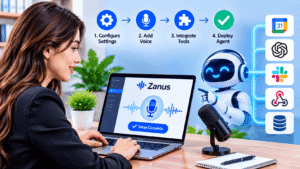
People assume the Zanus AI voice agent goes live in ten minutes because the demo looked effortless. The demo used a clean script, a quiet room and a pre-loaded calendar. Check each step below against Zanus’s actual onboarding.
- List your top call types. Review a week of calls and pick the three to five most common reasons people phone.
- Write the knowledge the agent needs. Hours, pricing rules, service areas, and what to say when it doesn’t know.
- Connect your systems. Calendar first, then CRM or helpdesk. Test one booking end to end.
- Connect the phone number. Forwarding is the lowest-risk start; porting and SIP trunking come later.
- Set handoff rules. Decide which topics or caller moods send the call to a person, and who picks up.
- Test with real voices. Different accents, bad lines, interruptions.
- Go live on a small slice. After-hours calls only, then read every transcript for a week.
Developers should ask what the agent can do through webhooks and the API, and what happens if the CRM times out mid-call. A voice agent that fails silently is worse than one that admits a problem. For a private system, add hardware, network and security review, plus an IT owner. See also how to set up an AI voice agent.
Test the messy cases on purpose. A hypothetical: an agent books twenty clean test calls perfectly, then meets a caller who says “Tuesday, no, wait, Wednesday morning” and books Tuesday. The clean tests never find that. The messy ones do.
Pricing and total cost: what to ask
I won’t print a price I can’t confirm, and prices change. Ask Zanus for a written quote for your exact plan, and ask what the first-year total includes: setup or onboarding fees, usage limits and overage rules, extra languages, phone charges, contract length and renewal terms. For a private system, add hardware, power, maintenance and IT time. And count your own hours spent writing the knowledge base and reviewing transcripts.
Then compare cost per resolved call, not cost per minute. Divide your total annual cost by the number of calls the agent fully resolves without a human, and compare that with what those calls cost you today. Use your own call data. See Zanus pricing explained.
Limitations: when a human should take over
An AI that can’t hand a caller to a human is a liability. Every deployment needs an exit.
Voice agents still struggle with heavy accents and noisy lines, so test with the callers you actually have. They struggle with angry or distressed people, who want someone to say “I’m sorry, let me fix this” and mean it; the agent should spot repeated requests for a person and transfer immediately. They shouldn’t handle high-stakes matters like medical advice, legal questions or billing disputes alone. And they can give smooth, confident, wrong answers to unfamiliar questions, so test with questions your knowledge base deliberately doesn’t cover.
Handoff to a human
Good handoff means the agent recognizes when to transfer, the transfer is fast, and the person who picks up sees what was already said. Many setups fail on that last part. Ask whether the Zanus AI voice agent passes a transcript or summary, and decide who covers handoffs after hours. A transfer to a line nobody answers is worse than no AI at all.
Zanus vs alternatives
Platforms differ widely, from developer toolkits to ready-made receptionist services. Judge every product on the same criteria: voice quality and latency on your own calls, languages and accents, integrations, pricing transparency, handoff options, data location and compliance features, support quality and contract terms.
Names that often come up in comparisons include Dialzara, Bigly Sales and RingCentral. They solve different problems, so they aren’t a like-for-like ranking; check each vendor’s current pricing and features on its own site. The real question isn’t “which is cheapest?” but “do I need a wider platform?” If you just need calls answered, a narrower service may fit. If you want one system for calls, chat and bookings, the Zanus AI system’s scope may justify a closer look. The fairest comparison is a two-week pilot of two or three platforms with the same script. See Zanus vs alternatives.
Choosing by business size
Small shops. AI receptionist for small business Zanus plans deserve a hard look at cost versus call volume. If you take five calls a day and mostly need messages relayed, a simpler tool may do. If you miss a dozen calls a week that would each be worth real money, the math changes. Start narrow. See AI receptionist for small business.
Growing service companies. The wider scope of the Zanus AI voice agent starts to make sense here, because calls, chat, bookings and follow-ups often share the same bottleneck. If the agent can’t write to your CRM or calendar, though, staff re-type what it collected and the savings vanish.
Privacy-sensitive practices and call centers. Clinics, law firms and finance teams should look at the private option and weigh the data benefit against the IT burden. Call centers need reporting, role-based access and clear handoff to live agents, so pilot on one queue first.
Agencies. Before you resell any AI voice platform, ask about white-label branding, multi-client management and reseller terms. Also ask what support you get when a client’s agent says something wrong at 9 p.m., because your client will call you first, not the vendor.
Compliance and privacy
Phone calls carry legal obligations, and an AI voice doesn’t remove them. Some places require one party’s consent to record, others require everyone’s. In the United States, the TCPA restricts certain automated calls and requires consent in many situations. GDPR applies to personal data in recordings and transcripts for callers in the EU and UK, CCPA may apply in California, and HIPAA may require a business associate agreement if you handle health information. Some jurisdictions expect callers to know they’re speaking with an AI; being upfront builds trust either way.
Be wary of any page that says “compliant by design,” including this one. Compliance depends on your agreements, retention rules, access controls and consent wording. This isn’t legal advice, so confirm your obligations with legal counsel and ask Zanus for its security and data retention documentation. See AI voice agent compliance and privacy.
Common mistakes
Launching on every line at once. Treating the script as finished (the first version is never right, so read transcripts weekly for a month). Hiding the AI, because people figure it out and feel tricked. Ignoring the unhappy path: test the cancellation, the wrong number and the caller who won’t stop talking. Skipping the handoff plan, which is the failure I’d bet on most. Buying on the demo, which shows the best case, instead of a trial on your own calls. And measuring “calls answered” when the number that matters is “calls resolved without the caller phoning back.”
Frequently asked questions
What is the Zanus AI voice agent?
It’s an AI system that answers business phone calls, books appointments, takes messages and transfers callers to a person when needed. Zanus is described as a wider business automation platform, so confirm exactly what your plan includes.
How does an AI voice agent work?
It converts the caller’s speech to text, uses a language model to work out the request, then turns its reply into spoken audio. It can also connect to your calendar or CRM so it completes tasks instead of only talking.
Is an AI voice agent better than a human receptionist?
For routine calls and after-hours coverage, often yes. For emotional, complex or high-stakes calls, no. Most good setups let the agent handle routine calls and keep a person ready for the rest.
How much does the Zanus AI voice agent cost?
Get a written quote for your plan and ask what the first-year total includes: setup fees, usage limits, extra languages, phone charges and renewal terms. Then compare it with cheaper call-answering tools.
Can the Zanus AI voice agent integrate with my CRM and calendar?
That depends on the built-in connections and whether webhooks or an API cover the rest. Ask for the integration list for your exact tools, then run one full booking test.
Can the Zanus AI voice agent make outbound calls?
Ask whether outbound calling is available on your plan. If so, sort out consent first and start with warm contacts, such as people who requested a callback.
Is it legal to use AI on calls?
Generally yes, with rules attached. Recording consent, outbound limits such as the TCPA, data protection laws like GDPR and disclosure expectations vary by location. Confirm with legal counsel.
Cloud or private: which should I choose?
Choose cloud if you want to start fast with no hardware and your data rules allow it. Choose private if privacy rules or call volume justify owning the hardware and you have IT capacity. If neither applies, choose something simpler.
Summary and next step
The Zanus AI voice agent is worth evaluating if you lose calls to busy hours, nights or thin staffing, and most of your calls follow patterns. It won’t pay off if you expect it to replace judgment or empathy on day one.
Success with the Zanus AI voice agent depends less on the brand and more on preparation: a narrow first scope, a tested handoff, honest scripts and weekly transcript reviews.
This week: list your ten most common call reasons, write down your monthly call volume, and send Zanus three questions. Which product applies to me, where is call audio processed, and what does the full first-year cost include? Then book a demo or trial and run it on your three hardest calls, including the messy ones. If it handles a noisy call and a handoff gracefully, you’ve learned what a polished demo can’t tell you.
Book a Zanus demo and bring your three hardest calls.
