

Quick heads-up before we get into it: if you’ve stumbled across names like “Pi123,” “Anon Vault,” or something similarly oddly specific while researching emerging tech, it’s worth pausing on those. I dug into a couple of them, and here’s what I found: dozens of articles online, all describing the “platform” completely differently. One calls it a math tool. Another says it’s a blockchain framework. Others call it an AI automation engine. No real company behind any of it, no consistent story, nothing you could sign up for. That’s not a hidden gem you missed; that’s just AI-generated filler content chasing curious search traffic.
Okay, with that out of the way. Here’s what’s moving the needle in business technology right now. Real platform, real research behind it, backed by Gartner, the World Economic Forum, and people who study this stuff for a living. No vague buzzword soup.
What Actually Makes Something “Emerging” in 2026?
Here’s the thing about the word “emerging”: it gets thrown around so loosely that it’s started to mean almost nothing. A technology is genuinely emerging when it’s moving from “interesting experiment” to “actually being used at scale,” not just when someone slaps a shiny name on it.
Generative AI is a good example of how fast that jump can happen. Enterprise adoption went from around 11% in early 2023 to roughly 65% by late 2024. And by 2024, 88% of organizations said they were using AI in at least one part of the business. That’s not hype, that’s an adoption curve you can chart.
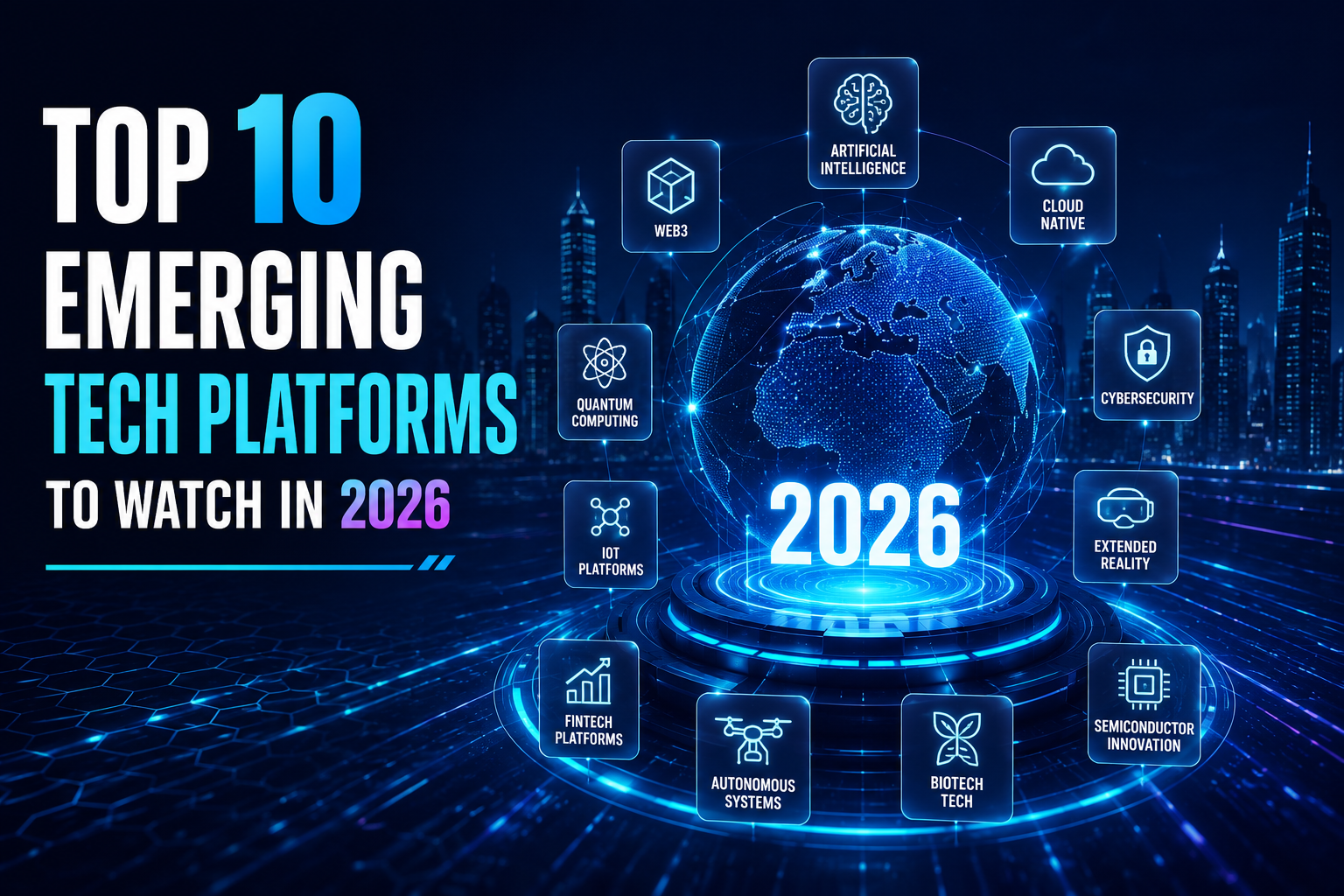
Top 10 Emerging Tech Platforms and Trends for 2026
1. Agentic AI and Multi-Agent Systems
This is a shift from “AI answers your question” to “AI goes and does the thing.” Agentic AI plans out multi-step tasks and carries them through on its own, rather than waiting for you to prompt it at every step. Gartner specifically calls out multi-agent systems as one of the defining trends of 2026. Instead of one giant model trying to do everything, you get smaller, modular AI agents working together on a complex task.
Cohere is a solid real-world example here. They help enterprises deploy custom AI models safely, and they’ve been pointed to by innovation researchers as proof that generative AI has moved from a side experiment into something genuinely embedded in daily operations.
You don’t have to be running an enterprise to see this same shift, either. It’s showing up in much smaller, everyday tools, too. Our breakdown of the best AI meeting assistants in 2026 covers a few tools that are already doing this same “act on your behalf” thing, just for something as simple as a work call.
2. AI-Native Development Platforms
These are development tools built around AI-assisted coding from day one, not older tools that bolted an AI feature on afterwards as an afterthought. Gartner puts this on its list of top strategic technology trends for 2026, and honestly, it reflects something that’s already obvious to anyone writing code right now: AI isn’t a plugin anymore; it’s baked into the whole workflow.
3. AI Supercomputing Platforms
As AI models get more complex, the infrastructure to actually train and run them has become its own category. These supercomputing platforms unlock real breakthroughs in model training, but Gartner is pretty blunt about the catch: this stuff needs serious governance and cost control. This isn’t something a business dabbles in casually.
4. Domain-Specific Language Models (DSLMs)
Instead of one general-purpose AI trying to be everything to everyone, domain-specific language models are trained specifically for one field: healthcare, law, finance, whatever. The payoff is better accuracy and stronger regulatory compliance than a general model can realistically offer.
This connects to something we’ve covered before: specialized tools tend to beat general-purpose ones once you’re in a regulated industry. Our Technology Solutions guide goes deeper into exactly why healthcare and finance specifically benefit from tuned, industry-specific technology instead of a one-size-fits-all platform.
5. Physics-based AI (Robotics and Smart Equipment)
Physical AI is what happens when intelligence stops living only on a screen and starts running actual equipment, robots, drones, and smart machinery doing real work. Current trend reports specifically point to record robot installations as proof that this is scaling in the real world, not staying stuck in a research lab.
6. Confidential Computing
Here’s a distinction worth knowing: confidential computing protects data while it’s actively being used, not just while it’s sitting quietly in storage. That matters more than it sounds, because it means secure AI and analytics work can now happen even on infrastructure a business doesn’t fully own or control. Gartner flags this as increasingly critical simply because more companies are running AI workloads on shared or third-party infrastructure than ever before.
7. Quantum Computing
Quantum computing keeps inching from pure research toward genuine commercial relevance, with the market racing toward a projected $97 billion valuation. It’s not something most businesses need to touch directly yet, but it’s worth keeping half an eye on, even if you’re not doing anything with it today.
8. Digital Provenance Tools
As AI-generated content gets harder and harder to tell apart from the real thing, digital provenance tools have emerged specifically to cryptographically verify where a piece of content actually came from. Gartner named this a top 10 strategic trend for 2026 for good reason: disinformation goes after what people trust, not just what systems they use, which makes content authenticity a real business and security concern, not just something journalists worry about.
9. IoT and 5G/6G Connectivity
The Internet of Things is really the foundation of everything else on this list, which quietly depends on it. Agentic AI, physical AI, predictive analytics, none of it works without real-time data flowing in from connected devices. With billions of devices already active, 5G maturing, and 6G research accelerating behind it, this connectivity layer is what makes basically everything else on this list practically possible.
10. Preemptive Cybersecurity and AI Security Platforms
Instead of cleaning up after a breach, preemptive cybersecurity platforms use AI to spot and neutralize threats before any damage happens. It pairs naturally with digital provenance; both are part of the same 2026 shift: prove trust and prevent harm up front, instead of reacting to it after the fact.
8 Types of Emerging Technologies (The Bigger Picture)
Zoom out past the specific platforms above, and most of 2026’s emerging tech falls into a handful of broader buckets:
- Artificial Intelligence & Machine Learning — everything from agentic AI to domain-specific models
- Quantum Computing — early days for most businesses, but moving fast
- Robotics & Physical AI — AI capabilities showing up in actual physical equipment
- Extended Reality (AR/VR/Immersive Tech) — powering new use cases in remote work and immersive experiences
- Biotechnology & Synthetic Biology — advancing right alongside digital tech, not separately from it
- Next-Generation Connectivity (5G/6G) — the infrastructure layer sitting underneath nearly everything else
- Cybersecurity & Digital Trust Tools — confidential computing, digital provenance, all of it
- Sustainable & Climate Tech — increasingly treated as core infrastructure planning, not a side project anymore
How This Stuff Actually Shows Up in Everyday Business Tools
It’s easy to read a list like this and assume it only matters if you’re running a massive enterprise with an R&D budget. In reality, a lot of it is already quietly baked into the tools smaller businesses use every single day:
- Agentic AI shows up in tools that build your entire day for you instead of just displaying a calendar you still have to manage yourself. Our guide to AI calendar apps covers a few already doing exactly this
- AI-native workflows show up in note-taking and task tools that don’t just store your information but actually act on it. Check out our picks for the best AI note-taking apps and best task management apps if you want to see this in action.
- Domain-specific AI is increasingly baked into CRM platforms built around one specific industry rather than trying to serve everyone. Our breakdown of the best CRM software for real estate agents is a good example of a familiar category (CRM) getting reshaped by industry-specific AI features.
How to Tell If an “Emerging Tech Platform” Is Worth Your Time
Given how many genuinely new platforms are out there and, as we covered up top, how many aren’t real at all, here’s a quick gut-check that works:
Can you find a real company behind it? A legitimate platform has an actual business entity, real leadership, and a support channel you can contact, not just scattered blog posts describing it in five different, contradictory ways. Speaking of which: does independent coverage even agree on what it does? If every source you find tells a different story, that’s not versatility, that’s a red flag.
Also worth checking is whether there is an actual case study or a verifiable user base. Real platforms tend to have identifiable customers, reviews on established sites like G2 or Capterra, or coverage from credible tech journalism, not just SEO-optimized explainer posts that all read suspiciously similar.
And perhaps the most important question of all: does it solve a problem you have? This applies just as much to the legitimate stuff on this list as it does to the sketchy stuff. Adopting quantum computing or agentic AI because it’s trending, rather than because it fixes something real, rarely pays off. Our Digital Transformation Solutions guide gets into this exact mistake in more depth. It’s the same reason most transformation projects fail to hit their goals in the first place.
Frequently Asked Questions
What are the top emerging tech platforms for 2026?
Based on current research from Gartner and other industry analysts, the leading platforms and trends right now include agentic and multi-agent AI, AI-native development platforms, domain-specific language models, physical AI and robotics, confidential computing, and quantum computing.
What are the 8 types of emerging technologies?
Broadly speaking: artificial intelligence and machine learning, quantum computing, robotics and physical AI, extended reality, biotechnology, next-generation connectivity (5G/6G), cybersecurity and digital trust tools, and sustainable or climate technology.
How do I know if a “tech platform” I read about online is real?
Check whether independent, reputable sources describe it the same way, whether there’s a real company and support channel behind it, and whether it shows up on established review sites like G2 or Capterra. If the descriptions contradict each other or read like generic AI-written filler, treat them with real suspicion.
Do small businesses need to worry about things like quantum computing? Not directly, and not yet. Trends like quantum computing and AI supercomputing matter more to large enterprises and specific research-heavy industries right now. Smaller businesses tend to get more immediate value out of AI-native productivity tools, industry-specific CRM features, and better cybersecurity, all things already available today, not five years out.
Final Thoughts
The technologies genuinely reshaping business in 2026, agentic AI, domain-specific models, physical AI, confidential computing, are backed by real research, real companies, and adoption curves you can actually measure. Not everything wearing the label “emerging tech platform” clears that bar, and it’s worth staying a little sceptical of names that seem to be everywhere online but trace back to nowhere in particular. When in doubt, look for a real company, a real support channel, and a real reason it solves something you actually deal with. That one filter alone will keep you ahead of the hype instead of chasing it.
