

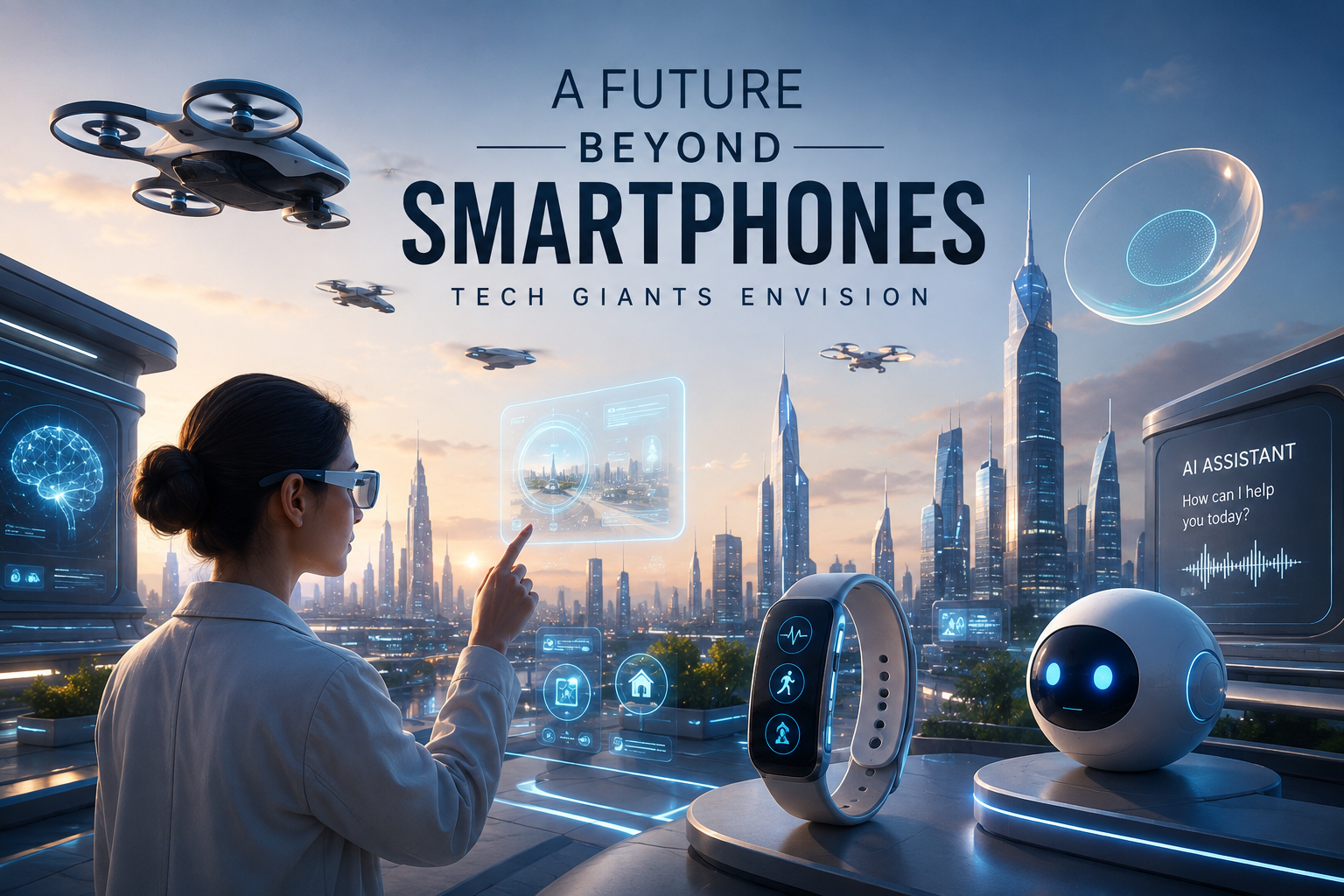
You’ve probably felt it, even if you couldn’t name it, that low-grade boredom every time a new phone launches. A slightly better camera, a slightly brighter screen, a battery that lasts an extra hour. Nobody’s lining up outside an Apple Store anymore the way they did in 2010. And it turns out it’s not just you getting older and grumpier about tech.
The companies that build these things have noticed the same thing, and they’re already spending tens of billions of dollars on what comes next.
Here’s the honest version of the story, because a search for this exact topic right now pulls up a dozen articles all saying roughly the same vague thing: “AI is the future,” “glasses are coming,” “imagine your life in 2035” – without naming a single real product, price, or date.
So let’s get specific about who’s building what, what’s already in people’s hands, and what’s still just a slide in an investor deck. If you want the wider picture of what’s driving this shift, our guide to the top emerging tech platforms in 2026 covers the AI and connectivity trends making all of this possible in the first place.
So What Are Tech Giants Actually Building?
The short version: smart glasses, AI-powered wearables, and voice-first assistants that don’t need a screen to work. The idea isn’t that your phone explodes on a Tuesday and everyone switches to something new overnight. It’s a slow shift where you reach for your phone less and less, because something lighter is already doing the job.
As one Meta executive put it well in an internal comment reported by industry outlets, the company isn’t trying to replace the phone overnight, just build a parallel system that gradually becomes more useful than pulling out your phone a hundred times a day. That’s really the whole strategy in one sentence, and it’s the same one Apple, Google, and Samsung are quietly running too.
Meta: Already Ahead, and Not Being Subtle About It
Out of every company chasing this, Meta is the one furthest along, and Mark Zuckerberg isn’t shy about saying so. On Meta’s Q4 2025 earnings call, he compared this moment to the shift from flip phones to smartphones, saying it’s hard to imagine a world in a few years where most glasses people wear aren’t AI glasses. He’s since gone as far as taking business calls on a jet ski while wearing his $800 Ray-Ban Meta glasses, telling reporters the other person on the call couldn’t even tell.
The numbers back up the confidence, at least so far. Meta sold more than 7 million pairs of Ray-Ban smart glasses in 2025 alone, and by IDC’s tracking, the company now holds over 72% of the global smart glasses market. Xiaomi is a distant second at around 4%. This is not a science project. It’s a real, shipping product category Meta is already winning.
It’s not cheap, though. Meta’s Reality Labs division, the unit behind all of this, posted a $19.2 billion loss in 2025, and the company’s 2026 spending on this bet could hit as much as $145 billion. Zuckerberg’s answer to the obvious question of “why keep spending” has been consistent: build something that can reach billions of people first, and figure out how to make money from it once you’re at scale. It’s the same playbook Meta ran with Instagram and WhatsApp.
Apple: Moving Slower, and Recently Losing Key People
Apple’s version of the story looks a lot less certain right now. The company poured around $8.3 billion into spatial computing and launched the Vision Pro at $3,499, and it hasn’t gone the way Apple hoped. Roughly 500,000 units were sold in year one, dropping to just 45,000 by the fourth quarter of 2025. Reviewers kept circling back to the same three problems: a two-hour battery life, eye strain reported by nearly half of users, and a nagging sense that beyond “really expensive Netflix goggles,” nobody was quite sure what the thing was for.
Apple’s actual smart glasses, reportedly code-named N50, were originally supposed to be unveiled by the end of 2026. That date has already slipped once, now targeting a late-2027 launch, with a lighter “Vision Air” headset pushed even further, to 2028 or 2029.
Then, in a genuinely rough turn for the program, Paul Meade, the VP who spent seven years building Vision Pro’s hardware and had taken over the smart glasses effort, left Apple in June 2026 to join OpenAI’s hardware division instead. It’s not a minor loss, either; he’s specifically the engineer who understood how to cram real AI processing into a 3-to-8-watt power budget light enough to wear comfortably on your face.
Google: Betting on Android’s Home-Field Advantage
Google’s approach leans on something Apple and Meta don’t have: Android already runs on roughly 70% of smartphones worldwide, which gives Google a built-in distribution advantage the moment its glasses platform is ready. The company is investing around $5.7 billion in AR and AI, building Android XR in partnership with Samsung and Qualcomm rather than going it alone.
Demos of Google’s Project Astra have shown genuinely impressive real-time AI assistance, the kind of thing that watches what you’re looking at and answers questions about it instantly, no typing required. Samsung, for its part, has confirmed it’s building further consumer AR experiments tied to its Galaxy ecosystem through 2026, which suggests this Google-Samsung-Qualcomm alliance is more than just a partnership announcement. It’s an actual coordinated push. For businesses watching this space and wondering how to actually plan around shifts like this rather than just react to headlines, our Digital Transformation Solutions guide covers how to evaluate emerging technology without getting caught chasing hype.
Elon Musk: Skipping Glasses Entirely, Going Straight for the Brain
While everyone else is arguing about frames and lenses, Elon Musk has been making a very different, much bigger claim: that phones won’t be replaced by glasses at all, they’ll be replaced by nothing, because Neuralink’s brain-computer interface will let you communicate directly through thought. Responding to a post on X, Musk wrote plainly: “In the future, there will be no phones, just Neuralinks.
” At a more recent event, he went further, predicting that within five years, people would send messages, summon a car, or stream a movie directly from their mind, with no screen involved at all.
It’s worth being clear-eyed about where Neuralink stands today, though. As of the most recent public updates, the company has implanted its chip in a small number of human patients, starting with Noland Arbaugh, a man paralyzed from the shoulders down, who has used the implant to control a cursor and play games like chess purely with his thoughts. It’s a genuinely remarkable medical result and a long way from being a mainstream smartphone replacement that anyone could walk into a store and buy.
Musk himself has floated a future price point somewhere between $1,000 and $2,000, similar to a smartphone or an Apple Watch, but that’s still speculative pricing for a device that currently requires actual brain surgery to install.
What Do These “Post-Smartphone” Devices Actually Do Right Now?
Strip away the future-tense marketing language, and here’s what’s genuinely working today, not five years from now:
- AI voice assistant without opening an app — ask a question out loud, get an answer, no screen required
- Real-time translation and object identification through the camera built into the smart glasses
- Hands-free photo and video capture — Ray-Ban Meta glasses already do this well enough that 7 million people bought a pair in a single year
- Ambient, context-aware suggestions based on what you’re doing, rather than notifications interrupting you
- Basic navigation overlays showing directions in your field of view instead of on a screen you’re holding
This “AI acts before you ask” pattern isn’t exclusive to headsets and glasses, either — it’s the same shift already showing up in everyday software. Our roundup of the best AI meeting assistants and best AI calendar apps covers tools doing this exact thing on a laptop or phone today, well before anyone’s wearing it on their face.
What’s notably not fully working yet: all-day battery life on anything powerful enough to matter, AR displays sharp and bright enough to fully replace a phone screen, and a price point most people would consider reasonable for a gadget this experimental.
The Part Most Headlines Don’t: Phones Aren’t Actually Dying Yet
Here’s something worth sitting with: people aren’t ditching their smartphones. If anything, they’re holding onto them longer than ever. A recent Allstate Protection Plans survey found that 21% of U.S. phone owners now wait until their device physically breaks before replacing it, and only 22% upgrade within 12 months.
Compare that to the near-annual upgrade cycle that used to be normal, and it’s clear something has shifted – not toward abandoning phones, but toward treating them as a mature, “good enough” technology instead of something exciting to chase every year.
That boredom is part of the whole story here. Separate research from Mintel found 78% of Americans now feel tech brands focus more on flashy features than on things that are actually useful, which is exactly the gap Meta, Apple, and Google are all racing to fill with something that feels genuinely new again, instead of just a slightly better camera bump.
Privacy: The Part Nobody’s Fully Solved
Before getting too excited about any of this, it’s worth being honest about the trade-offs. A Swedish investigation into Meta’s smart glasses found that subcontractors were labelling footage captured through the devices, including personal content users likely never intended to share. The recording indicator light, meant to tell people nearby that they’re being filmed, has reportedly been disabled in some cases.
And a proposed “Name Tag” feature, designed to identify strangers just by looking at them through the glasses, has already drawn a formal complaint requesting an FTC investigation.
These aren’t small footnotes. If cameras and microphones are going to live on your face all day instead of in your pocket, the conversation about consent, recording, and data handling has to catch up fast and right now, it’s clearly behind where the hardware already is.
If you’re evaluating any AI-powered tool for daily use, not just wearables, it’s worth applying the same scrutiny. Our guides to the best AI note-taking apps and the best task management apps both flag data-handling questions worth asking before adopting any AI tool, headset or otherwise.
Will Phones Still Exist in 2050?
Almost certainly, yes, just not necessarily as the device you reach for first. The more realistic picture emerging from how these companies talk about the transition is that smartphones gradually shift into becoming a background hub, the thing doing the heavy computing and connecting to the network, while glasses, wearables, or eventually something like a brain interface become the actual point of daily interaction.
Zuckerberg himself has said this shift could take “a decade or more” even for people who don’t currently wear glasses at all, which is a far more measured timeline than the flashier headlines suggest.
Frequently Asked Questions
What will be the next big thing after smartphones?
Right now, the leading contenders are AI-powered smart glasses (led by Meta, with Apple and Google both racing to catch up), voice-first AI assistants that don’t require a screen, and much further out, brain-computer interfaces like Neuralink. Smart glasses are the furthest along, since Meta is already selling millions of units.
What did Elon Musk say about phones?
Musk has said that in the future, there will be “no phones, just Neuralinks,” predicting that brain-computer interfaces will eventually let people message, browse, and stream content directly through thought, without any screen at all. He’s suggested this could happen within about five years, though Neuralink is currently still in early human trials.
Will phones still exist in 2050?
Most likely, yes, but probably in a different role. Tech leaders increasingly describe a future where the smartphone becomes more of a background hub handling computing and connectivity, while glasses, wearables, or other interfaces become the primary way people interact with technology day to day.
What will Mark Zuckerberg replace smartphones with?
Zuckerberg is betting on AI-powered smart glasses. He’s compared this moment to the shift from flip phones to smartphones and said it’s hard to imagine a future where most glasses people wear aren’t AI glasses, with Meta already holding more than 70% of the current smart glasses market.
Final Thoughts
Nobody’s phone is turning into a paperweight next year; that part of the internet hype cycle is getting ahead of itself. What’s actually happening is quieter and, honestly, more interesting: Meta is already shipping smart glasses by the millions, Apple is stumbling and losing key people while trying to catch up, Google is leaning on Android’s massive reach, and Elon Musk is making a much longer, stranger bet that skips glasses entirely in favour of your brain. The device in your pocket isn’t going anywhere soon, but the thing you reach for first, several years from now, might not be a phone at all. For a broader look at where all this fits into the bigger technology picture, our Technology Solutions guide breaks down how AI, cloud, and connected devices are reshaping business and daily life well beyond just phones and glasses.
