

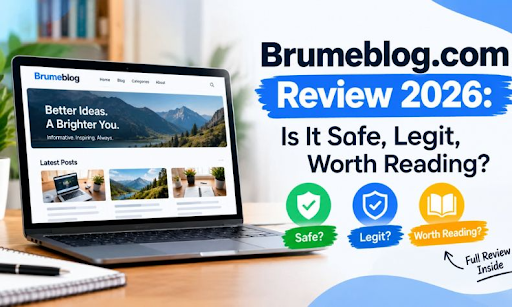
Brumeblog com is a general-interest WordPress blog that publishes on business, health, finance, technology, travel, pets, law and more. It is a real, active site with fresh posts dated this week. It also has a one-line author bio, a personal Gmail address for contact, no named company and no editorial team. Fine for casual reading. Not a source to cite or to take medical, legal or money advice from.
Homepage checked on October 7, 2026. Anything I could not open myself is marked as reported by other reviewers.
What is brumeblog com?
The site calls itself “Brume Blog.” Its own description promises a wide variety of magazines on fashion, lifestyle, entertainment, technology, business, sports and more, and says it partners with leading publishers.
Now look at the front page. There are no magazines. No publisher logos. No partner list. What you get is a plain blog feed: headline, date, thumbnail, two or three lines of excerpt, category tag, “Read more.” The self-description and the site do not match, and that gap is the first thing worth knowing.
None of this makes it a bad site. Plenty of small blogs oversell themselves in a meta description. It just means you should judge the pages, not the pitch.
Which address is the real one?
Three similar addresses circulate, and mixing them up is how people end up reading the wrong thing.
brumeblog.com is the active site. Its canonical tag points to itself, its newest posts are dated October 6 and 7, 2026, and its archive runs to 16 pages.
brumeblog.it.com has its own About page, written in generic language about “valuable, easy-to-understand” information and “accurate and updated” content. It names no person, no company and no place. That text could describe any website on the internet. I found nothing that links it to the .com site.
brume-blog.com, with a hyphen, is another lookalike. One reviewer who compared the two reports a different theme, a different menu and a different byline (William Marchand). I did not check this one myself, so take that as a lead, not a finding.
The short rule: type the address yourself, and treat every lookalike as a separate site until something proves otherwise. A link from an unknown email or social post is not proof.
TechTrendery.com USA: Your Guide to Tech News, Reviews, and How-To Guides
How old is it and how is it built?
Age is a trust clue, so here is what I could pin down. A site-icon image on the homepage sits in a folder dated December 2023, which fits a late-2023 launch. Reviewers also mention posts from 2023 and 2024 in the archive. So: roughly three years old, not brand new, not an established media outlet either. The exact registration date needs a WHOIS lookup, which I did not run.
The technical setup is ordinary. The page source shows WordPress with Google’s Site Kit plugin, the GeneratePress theme in the footer, and an Ahrefs site-verification tag, which means somebody connected the site to an SEO tool. The robots tag allows indexing and full snippets. I did not test the XML sitemap, the RSS feed or Core Web Vitals, so I will not grade them.
One visible rough edge: the “Home” link in the top menu sends you to a theme demo site (demo.adorethemes.com), not to the blog’s own front page. Small thing. It also suggests the site has not had a careful once-over since setup.
Who runs the site?
This is the section most competing pages dodge, so let me be direct about what is known and what is not.
The footer lists a single email: writerjohnrayne@gmail.com. Every current post on the homepage carries one byline, a username-style handle (brumeblog_wzbwpv), not a human name.
Older posts, according to several independent reviewers, are credited to Devin Haney and Shivi Hyde. The “About me” box is reported to describe Devin Haney in one sentence: someone who has self-produced and hosted blogs in the multi-niche space and researches trends and news. No credentials, no work history, no company name, no editorial team and no stated fact-checking process are reported anywhere. I could not open that About page myself, so this comes from other people’s reading of it.
Put that together and you get a one-person or very small operation. That is not a crime. But a site that runs health, finance and law categories with that level of author detail has not earned much authority yet. Google’s own quality guidance leans heavily on who wrote something and why they are qualified, especially for topics that affect health or money.
What topics and categories does it cover?
Broad is the polite word. The homepage lists 22 categories: AI, Blog, Business, Crypto, Education, Fashion, Finance, Game, Health, Home, Law, Lifestyle, Literature, Online Game, Pets, Real Estate, Sports, Technology, Trading, Travel, Uncategorized and Websites. The top menu trims that to seven: Business, Education, Finance, Health, Lifestyle, Technology and Travel.
Recent headlines show how mixed it gets:
- Product Inspection in China for Online Sellers Shipping to Amazon FBA (Business)
- Why Billboards Still Work in a Digital World (Business)
- Speed Wins Deals: What Investors Should Know About Private Real Estate Financing (Real Estate)
- A Fifteen Minute Briefing for a Thirty Day Recovery (Health)
- The Ground-Level Clue Most Back Pain Cases Miss (Health)
Reviewers also report older pieces on THC detox tips, when to see a neurosurgeon, a Pomeranian-Chihuahua mix, an Iceland road trip, criminal law and divorce, and casino payment methods. That is a very wide net for one small site.
Tech Giants Envision a Future Beyond Smartphones
Patterns worth noticing
Eight of the posts on the front page are dated September 11 or 12, within about 48 hours. Several of them are about aging in place and home care in named US counties: Wake County in North Carolina, Guilford County, Montgomery County. Others look odd in their category. A piece on aging in a Gaithersburg home is filed under Business. An article on iron gates and railings in home renovation sits under Business too.
That clustering looks like content written around local service providers. The site does not say so, and I saw no sponsorship label or ad disclosure on the homepage. I cannot prove anyone paid for these posts. What I can say is that a reader has no way to tell, and that is a transparency problem on its own.
What the writing is like
Credit where it is due: the excerpts are clean and readable. The Amazon FBA piece opens on a real seller problem, a batch of 3,000 units with defects turning into returns and bad reviews. The billboard piece starts from a sharp, arguable idea. This is not the garbled, machine-spun text you find on the worst content farms.
But look at the other side. A health post titled around “the ground-level clue most back pain cases miss” makes a claim about how foot imbalance travels up the spine. No author credential on the page, to my knowledge, backs that up. Readable and reliable are different things.
Who is brumeblog com for?
The curious reader who saw the name in a search result. You will find a normal-looking blog, a free read and nothing that demands your data.
The cautious visitor. The homepage asks for no login, no payment and no download. Good start. Only the homepage, though.
The aspiring writer. I found no “write for us” page or submission guidelines I could verify. Only the footer email exists. Any promise of a guest post program from a third-party review is unconfirmed. If you pitch, send a title, a two-line summary and a link to your work. Never pay for placement.
The marketer or SEO person. The site is indexable and set up for tracking. Whether a link from it carries value is doubtful, given the scattered topics, the thin ownership details and the unlabeled local content. Ask for traffic proof before you pay for anything.
The student or researcher. Do not cite it. Use it to find a topic lead, then go to the original source: a government agency, a regulator, a peer-reviewed paper.
Is brumeblog com safe?
Two questions hide in that one. Safe to open? Probably, based on the homepage. Safe to trust? Different answer.
I did not run VirusTotal, Google Safe Browsing, ScamAdviser or a WHOIS lookup for this article, so I am not going to invent results. You can run all four in five minutes.
The 5-minute safety checklist
- Check the padlock. Confirm HTTPS and a valid certificate. Click the padlock to see who issued it and when it expires. Keep in mind that the US Federal Trade Commission warns scam sites also use encryption, so a padlock proves the connection is private, not that the owner is honest.
- Run the address through Google Safe Browsing and VirusTotal. Paste the full address, brumeblog.com, into each. A clean result is not a quality stamp. A flagged result ends the discussion. ScamAdviser gives a third opinion, though its scores lean on automated signals, so do not treat the number as a verdict.
- Look up the domain with ICANN Lookup. Check the creation date, registrar and expiry. A domain registered a few months ago that claims years of authority deserves a raised eyebrow. Hidden owner details are common and not a red flag by themselves.
- Read the About, Contact and Privacy Policy pages. You want a named person or company, a way to reach them and a statement about what happens to your data.
- Test the content. Open two articles on a subject you know well. If they are vague, wrong or quietly promotional, that tells you about the rest.
Trust signals on the site
| Trust signal | What to look for | What brumeblog com shows |
| HTTPS | Valid certificate, no browser warnings | Loads over HTTPS; certificate not inspected |
| Author transparency | Named writers with real bios | Homepage shows one handle; older bylines reported with a one-line bio |
| Contact info | Business email or contact form | One personal Gmail address in footer |
| Ownership | Company name, address, registration | None found |
| About page | Names, mission, location | Not verified on the .com; the .it.com version is generic |
| Ad / sponsor disclosure | Clear labels on paid content | None seen on the homepage |
| Content freshness | Recent dated posts | Posts from October 2026; 16 archive pages |
| Navigation polish | Every menu link stays on the site | “Home” link points to a theme demo site |
How to check any blog yourself
The same routine works anywhere. Look at the date before the headline. Find the author and ask what qualifies them to write about this exact topic. Check whether claims link to primary sources, such as official data or studies. Search a distinctive sentence from the article in quotes to see if it is copied elsewhere. Then compare one key claim with an authority in that field: a health agency for medicine, a financial regulator for money, a bar association or court site for law.
If you want this broken out further, see our guide to how to check if a blog is trustworthy and how to evaluate website trust signals.
Does it have ads, sponsors or affiliate links?
Here is what I can say with a straight face: the homepage showed no ad blocks, no pop-ups and no sponsor labels when I loaded it. That is all. I did not read every post, and ad code can load differently by country, device or browser.
Some competing reviews state flatly that the site earns money through affiliate links, display ads and labeled sponsored editorials, and even describe its ad placement rules. Treat that as invented unless the writer can point to a page on the site that says so. I found no such policy.
If you see a post that reads like a recommendation for one local company or one product, ask yourself whether you would know if it were paid. On this site, today, you would not.
Why are so many reviews of brumeblog com nearly identical?
Search the name and you will find dozens of “guides” and “reviews,” many published within weeks of each other, many using the same phrases: “multi-niche,” “modern readers,” “broad editorial approach.” Some are thin enough to say nothing checkable at all. A few invent features the site does not have, such as four neat content pillars, a five-stage editorial process or a strict no-ads policy.
Why would anyone write 800 words about a small blog? Because a brand-name keyword with little competition is easy to rank for. People searching it want a quick answer, and publishers know it. So when a review only says the site is “great for modern readers” and cannot name a single post, a date or an author, close the tab.
Strengths and weaknesses
What the site does well
It is active, with a deep archive and categories that work as filters. It loads like a normal blog, the excerpts read cleanly, and nothing on the front page tries to trick you into clicking. Some posts tackle concrete problems rather than offering generic advice. Reading is free with no signup wall.
Where it falls short
- No visible editorial team. For health, finance and law categories, that is a real gap.
- Thin author information. One sentence, no credentials, no named reviewer.
- Scope creep. Twenty-two categories, from crypto to pets to literature, is a content bucket, not a topical focus.
- Unlabeled local content. Posts about care services in named counties read like marketing. If they are, readers should be told.
- Claims that do not match the pages. “Magazines” and “leading publishers” are never shown on the front page.
- A personal Gmail as the only contact. Fine for a hobby blog. Weak for anything that touches health or money.
How much to trust it, by topic
Not every category deserves the same level of caution.
Travel and pets: low stakes. A road-trip planning post or a breed guide is fine as a starting point. Check dates, prices and rules with official sources before you book or buy.
Technology and business: moderate stakes. Useful for background. Cross-check any tool recommendation, since you cannot tell whether it is independent.
Health: high stakes. Do not use this site to decide on treatment, medication or when to see a specialist. Go to a national health service or a public medical library, then your doctor.
Finance, trading, crypto and real estate: high stakes. Posts on private lending, trading or crypto are not a substitute for a licensed adviser, and rules differ by country. Check the regulator for your country.
Law: high stakes. Laws differ by place and change over time. An explainer on a legal term is fine for vocabulary. It is not advice.
Top 10 Emerging Tech Platforms to Watch in 2026
How to contribute or contact the team
What I could verify: one email address in the footer, writerjohnrayne@gmail.com. Reviewers describe the same single Gmail address on the contact page.
What I could not verify: a formal guest post program, rates, editorial guidelines or turnaround times. If a third-party page says the site “accepts guest posts” and lists requirements, treat that as unconfirmed. Our notes on guest post guidelines explain what a real submission page should contain.
How brumeblog com compares with other multi-niche blogs
A good multi-niche blog does one of two things. It has a strong editorial voice that ties the topics together, the way a magazine does with named columnists. Or it has clearly separate sections, each run by someone who knows the subject.
This site has neither yet. It has volume and variety, which is the profile of a content site built for search traffic rather than a publication with a point of view. That is not automatically bad. It means you should read it like an aggregator: for leads, not final answers.
Sites that do this better tend to show the same things: named editors, author pages with real backgrounds, a correction policy, labeled sponsored content, and a company or masthead page. If those are missing, the label “magazine” is just a label. For a closer look at the difference, see how to tell a real multi-niche blog from a content farm and our piece on multi-niche blogging.
If you want a safer route for specific subjects, go straight to the source type that fits: a national health service or medical library for health, a financial regulator for money, official government sites for law and travel rules, and academic databases for research.
FAQs
What is brumeblog com?
A multi-niche blog on WordPress covering business, health, finance, technology, travel, pets, law and other topics, with new posts most weeks.
Is brumeblog com safe?
Nothing on the homepage asked for logins, payments or downloads. I did not run malware scanners, so use the checklist above before you enter personal data anywhere.
Is brumeblog com legit?
It is a real, working, regularly updated site. Whether it is a credible publication is another matter. With a one-line author bio, no company and no ad disclosure, I would call it low-trust for anything important.
Which brumeblog com address is official?
Use brumeblog.com. The .it.com and hyphenated versions look like separate sites, and nothing I found connects them.
What topics does brumeblog com cover?
Twenty-two categories, including AI, business, crypto, education, fashion, finance, health, law, real estate, sports, technology, travel and pets.
Is brumeblog com free?
Everything I saw was open to read, with no paywall or signup.
Who runs brumeblog com?
Not clearly stated. Reviewers name Devin Haney and Shivi Hyde as authors. The homepage shows one handle. No company or editor is named, and the only contact is a Gmail address.
Can I write for brumeblog com?
There is no verified submission page. You can email the footer address, but nothing promises a reply. Never pay to be published.
How do I contact brumeblog com?
By email at the address in the footer. I saw no contact form on the homepage.
Why does brumeblog com show up in my search results?
The name is a unique brand term, and the site has many indexed pages across many topics. Add to that the wave of review-style articles about it. Ranking says nothing about quality.
Can I trust the information on brumeblog com?
For travel ideas or light reading, sure. For health, money or legal decisions, no. Check any claim against an official source.
Does brumeblog com require signup?
Not for reading, based on the homepage.
Is brumeblog com good for beginners?
The writing is plain and easy to follow, so yes for readability. But beginners are the people most likely to take advice at face value, and that is the risk.
Does brumeblog com have an app?
I found no sign of one. Do not install anything claiming to be the official app unless the site itself points to it.
Final verdict
Brumeblog com is a working, regularly updated general blog. Nothing visible on its front page marks it as a scam, and nothing on it earns the right to be treated as an authority.
My call: fine to browse, not fine to cite, and not a place to take health, finance or legal advice. If you are a writer, do not count on a clear submission route until the site publishes one. If you are a marketer, ask for hard traffic and editorial proof before you pay for a link.
Whatever you decide, run the five checks yourself. They take five minutes and they work on any site, not just this one. Start with our guide on how to check if a blog is trustworthy, and then compare notes.
Stop Wasting Hours on Confusing Product Pages
Too many tabs, too many buzzwords, too little time. SoftwareCora gives you clear, honest guides and comparisons, so you can pick the right tool with confidence.
Know a gadget or tool that isn’t what its name suggests? Read our Write For Us guidelines and send your topic pitch today.
