

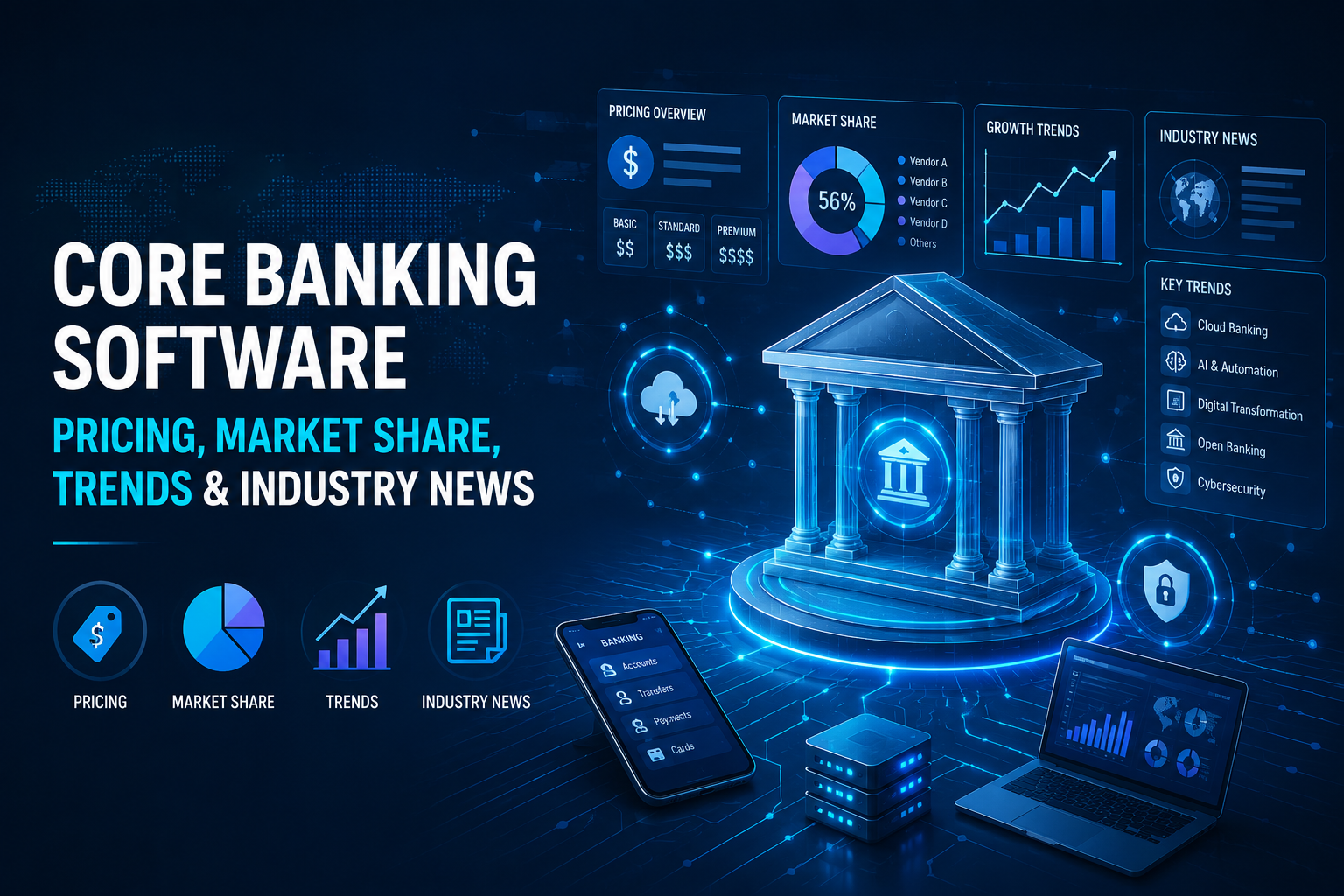
Most banks never see the real price tag for core banking software until they’re deep in a sales call. This guide fixes that. Using vendor financial filings, marketplace listings, and 2026 industry research, we break down what core banking software costs, who really controls the core banking software market, and where AI and online banking are pushing the industry next, all in plain, simple language.
Market Overview
The core banking software market covers the technology that runs a bank’s accounts, payments, loans, and online banking services behind the scenes. Every time a customer checks a balance, moves money, or applies for a loan through their bank’s website or app, a core banking system is doing the real work in the background.
Research firms don’t always agree on exact numbers, since each one defines and measures the core banking software market a little differently. But the overall story is the same everywhere: this is a large, fast-growing market, driven by banks replacing old systems, launching online banking, and adding AI.
Market Size
Estimates of the global core banking software market size in 2025 range from about 13 billion to nearly 20 billion U.S. dollars, depending on the research firm and exactly what they count as “core banking software.” Growth projections are consistently strong across nearly every report:
- Grand View Research: $13.32 billion in 2025, growing to $28.48 billion by 2033 (10.2% CAGR)
- Fortune Business Insights: $19.67 billion in 2025, growing to $83.78 billion by 2034 (17.4% CAGR)
- Precedence Research: $13.79 billion in 2025, growing to $35.98 billion by 2035 (10.07% CAGR)
- IMARC Group: $16.3 billion in 2025, growing to $45.9 billion by 2034 (11.59% CAGR)
- Cloud/SaaS core banking specifically: $14.3 billion in 2026, growing to $53.3 billion by 2033 (20.7% CAGR), per Persistence Market Research
North America currently leads the core banking software market, holding roughly 29% to 42% of the global share depending on the report, thanks to heavy modernization spending and a strong base of established vendors. Asia Pacific is consistently named the fastest-growing region, driven by financial inclusion programs in countries like India, Indonesia, and the Philippines.
Market Share
Exact, vendor-by-vendor market share numbers are hard to find publicly, since most core banking contracts are private and custom-priced. However, one useful data point comes from SDK.finance’s own 2026 market outlook: it notes that roughly 55% of the core banking software market is controlled by just five major vendors, highlighting how concentrated this space still is at the top.
Across nearly every major research report, the same names keep showing up as market leaders: Temenos, Oracle (through EdgeVerve and FLEXCUBE), Infosys, FIS, and Fiserv. Below them sits a large second tier that includes Finastra, Jack Henry, TCS, Capgemini, HCL, Sopra Banking Software, Mambu, and Thought Machine.
Leading Vendors
The vendors most frequently named as core banking software market leaders across 2026 industry reports include:
- Temenos ranked #1 core banking provider for 21st consecutive year by IBS Intelligence
- FIS, one of the largest financial technology companies globally by revenue
- Oracle (FLEXCUBE) and Infosys (Finacle), both leading global, multi-country deployments
- Fiserv, dominant among U.S. community banks and credit unions
- Finastra, Jack Henry, TCS, Sopra Banking Software, Mambu, and Thought Machine form a strong second tier.
Temenos T24 (now branded Temenos Transact) deserves a special mention here, since it’s one of the most reviewed core banking products on marketplaces like Capterra, currently holding a 4.4 out of 5 rating across 69 verified reviews, with 93% of reviewers rating it above 4 stars.
Pricing Models
Core banking software pricing generally falls into a few clear tiers, based on actual pricing data from vendor filings, marketplace sources, and public core banking software pricing reviews:
| Pricing Tier | Typical Cost | Notes |
| Tier-one enterprise (Temenos, FIS, Oracle, Finacle) | ~$290,000 – $1,000,000+ per year | Custom quote based on modules, institution size and transaction volume |
| Mid-market / challenger core (e.g. Basella-style SaaS) | €8,000 – €10,000 per month | Plus a one-time deployment fee of roughly €10,000 – €15,000 |
| Full source-code license (own and self-host) | From around €400,000 one-time | Perpetual license, unlimited modifications, no ongoing vendor fee |
| Smaller SaaS / niche core tools | Roughly €999 – $1,000 per user, per month | Common starting prices seen on marketplaces like Capterra and GetApp |
Take FIS as a concrete example. FIS doesn’t publish official pricing, so analysts instead divide its Banking Solutions annual recurring revenue of (5.75 billion U.S. dollars in 2024) by its estimated client count. Depending on whether you use FIS’s public client figure of about 5,800 or a broader estimate of 20,000, that works out to roughly 290,000 U.S. dollars to nearly 1 million U.S. dollars per institution, per year. Fintech founders on Reddit report similar real-world figures, commonly citing 400,000 to 1 million US dollars annually for tier-one vendors like FIS and Temenos.
Smaller, mid-market vendors are far more transparent. One SaaS-based core banking provider, for example, publicly lists Core Only plans starting at 8,000 euros a month, and a Full plan with mobile apps and internet banking starting at 10,000 euros a month, both plus a one-time setup fee. The same vendor offers a full source-code license for banks that want to fully own and self-host their core, starting at around 400,000 euros as a one-time cost.
Implementation Costs
The subscription or license fee is rarely the biggest cost in a core banking software project. Implementation costs, covering data migration, staff training, integrations, and testing, often add significantly more on top, especially for larger banks. A few patterns show up consistently in core banking software pricing reviews and industry write-ups:
- One-time deployment or setup fees are common even on SaaS plans, often ranging from 10,000 to 15,000 euros for smaller platforms.
- Tier-one, enterprise-scale replacements typically run as multi-year programs, since data migration and regulatory testing take real time to get right.
- Professional services, not the software license itself, make up the fastest-growing cost segment in several market reports, as banks increasingly need outside help with integration and rollout.
A safe rule of thumb: budget at least as much for implementation and migration as you do for the first year or two of the software itself.
Cloud Pricing
Cloud and SaaS-based core banking software is priced differently from traditional, on-premise licenses, and it’s growing fast. The global SaaS-based core banking software market is projected to grow from about 14.3 billion US dollars in 2026 to 53.3 billion US dollars by 2033, a 20.7% annual growth rate.
Cloud pricing usually follows a subscription model, often scaling with the number of accounts, users, or transactions processed, rather than a large upfront license fee. Around 68% of banks globally had adopted cloud-native core banking platforms as of early 2026, and public cloud deployment is expected to lead with close to 46% share this year, since it lets banks launch new products in weeks instead of years, without maintaining their own data centers.
Current Industry Trends
A few clear trends are shaping the core banking software market heading through the rest of 2026:
- Cloud-first deployment is now the norm for new, digital-only banks, with close to 89% of neobanks and challenger banks launching on fully cloud-based cores.
- Legacy modernization remains a major bottleneck: roughly 42% of institutions still describe themselves as stuck dealing with older, rigid core systems.
- Vendor lock-in concerns are pushing some banks toward API-first and source-code-available alternatives, rather than being fully dependent on one vendor’s roadmap and pricing.
- Legacy infrastructure maintenance still consumes a large share, around 70% by some estimates, of total bank technology budgets, limiting how fast modernization can happen.
AI in Core Banking
Artificial intelligence has moved well past chatbots inside core banking software. Around 58% of banks are now prioritizing AI-integrated cores specifically for high-stakes automation, like compliance monitoring and predictive risk analysis, not just customer-facing features.
Vendors are racing to add these capabilities directly into their platforms. Temenos rolled out new embedded AI tools in 2026 to help banks personalize services and move faster. TCS BNCS launched an “AI Compass” toolset combining machine learning, generative AI, and pre-built agents for banking use cases. Banks running SaaS-based, AI-ready cores report up to a 30% reduction in operational costs, largely through faster processing and less manual back-office work.
Digital Banking and Online Banking
Core banking software is what powers online and mobile banking, even though customers never see it directly. Every balance check, transfer, and bill payment made through a bank’s website or app depends on the core system processing it correctly and instantly, in the background.
As more banking moves online, this connection matters more than ever. Around 60% of banks have now migrated at least 30% of their critical workloads to the cloud, specifically to support faster, more reliable online banking. Retail banking, which relies most heavily on online and mobile banking, represents the largest single end-user segment of the core banking software market, at close to 34% to 39% of demand, depending on the report. Digital-first banks, in particular, are choosing composable, API-first cores specifically because they make it easier to add new online banking features quickly, without waiting on a full system upgrade.
Latest News
A quick roundup of core banking software news from the past year or so:
2024 — FIS completes the sale of its majority stake in Worldpay, and now reports its Banking Solutions segment separately, focusing disclosures on core processing.
2025 — Mambu launches a new composable banking framework specifically built for North American credit unions.
2025 — Fiserv announced plans for a new stablecoin, FIUSD, and a partnership with PayPal to connect it with PayPal USD for cross-platform payments.
2026 — Temenos was ranked the #1 core banking software provider for the 21st consecutive year in the IBS Intelligence Sales League Table, and rolled out new embedded AI capabilities.
2026 — TCS BaNCS launched its “AI Compass” toolkit, combining machine learning, generative AI, and pre-built agents for banking clients.
2026 — 10x Banking reported crossing 10 million live accounts and more than 30% annual recurring revenue growth, after reaching profitability in late 2025.
Future Predictions
Almost every major research firm expects double-digit growth in the core banking software market to continue through the early 2030s, even if their exact dollar figures differ. A few predictions came up repeatedly across 2026 industry reports:
- Cloud and hybrid-cloud deployment will keep gaining share over pure on-premise systems, though large banks will likely keep some workloads on-premise for years yet.
- AI will move deeper into compliance, fraud detection, and risk analysis, not just customer-facing chat features.
- Demand for API-first, source-code-available alternatives will keep growing, as banks look to reduce dependence on any single tier-one vendor.
- Asia Pacific will remain the fastest-growing region, driven by financial inclusion initiatives and rapid online banking adoption.
- Legacy system replacement will remain slow and expensive for large banks, keeping professional services one of the fastest-growing cost categories in the market.
Frequently Asked Questions
How big is the core banking software market?
Estimates for 2025 range from about 13 billion to nearly 20 billion U.S. dollars globally, depending on the research firm, with most projecting 10% to 17% annual growth through the early 2030s.
What is the typical core banking software pricing structure?
Pricing usually falls into tiers: tier-one enterprise vendors like Temenos or FIS charge custom, often six or seven-figure annual fees; mid-market SaaS platforms charge a few thousand euros a month plus a setup fee; and smaller, niche tools often start around $1,000 per user per month.
How much do core banking software prices vary by vendor?
Significantly. FIS and Temenos-style tier-one platforms can cost 300,000 to over 1 million US dollars a year, while mid-market SaaS cores can start closer to 8,000 to 10,000 euros a month, and smaller marketplace tools can start under $1,000 a month.
What core banking software news should banks watch in 2026?
Key recent developments include Temenos being ranked the #1 core banking provider for the 21st year running, TCS BaNCS launching its AI Compass toolkit, and 10x Banking passing 10 million live accounts with strong revenue growth.
Is there any core banking software news today worth knowing about?
The most significant ongoing story is the shift toward AI-integrated, cloud-native cores, with vendors like Temenos, TCS BaNCS, and Fiserv all shipping new AI or digital asset features in 2026 to stay competitive.
Who are the top vendors by market share in the core banking software market?
Temenos, Oracle, Infosys, FIS, and Fiserv are the five vendors most consistently named as market leaders, together controlling roughly 55% of the market, according to SDK.finance’s 2026 analysis.
How does Temenos T24 compare on pricing and reviews?
Temenos T24, now called Temenos Transact, doesn’t publish public pricing, but it holds a 4.4 out of 5 rating across 69 verified Capterra reviews, with 93% of reviewers rating it above 4 stars, making it one of the most consistently well-reviewed tier-one platforms.
Final Thoughts
The core banking software market is large, growing fast, and still surprisingly opaque on pricing, especially at the top end. If you’re evaluating vendors, use published benchmarks like the ones above as a starting point, but always get a formal quote based on your specific transaction volumes, modules, and migration needs before committing. The gap between a mid-market SaaS core and a tier-one enterprise platform isn’t just about features, it’s often a difference of hundreds of thousands of dollars a year.

1 Comment
Pingback: Top Core Banking Platforms 2026: Modernize Legacy Systems